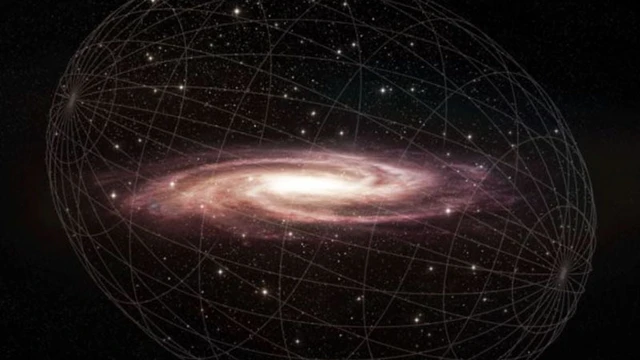
For too long, our perception of galactic stability has rested upon the illusion of an immutable night sky. Yet, contemporary astrophysical evidence reveals that the Milky Way underwent a violent spatial upheaval. A collision with a massive dwarf galaxy billions of years ago effectively knocked our stellar home on its side—a cataclysmic event that fundamentally shifted the orientation of the galactic disk and shaped the modern architecture of the Local Group.
The key to unraveling this cosmic drama lies in an anomaly within the dynamics of the stellar halo—the sparse, spherical region enveloping the Milky Way's primary disk. Data from the Gaia astrometric mission revealed a striking discrepancy: while the disk itself rotates around the galactic center at approximately 220 km/s, the stars within the halo exhibit an ordered motion of only 25 km/s. For years, this abrupt deceleration remained a mystery, attributed either to inaccuracies in estimating the galaxy's total mass or the specific distribution of dark matter.
However, the reality proved far more dramatic. Researchers from Durham University hypothesized that the halo's sluggish rotation is the consequence of a radical shift in the entire system's spatial orientation. To test this theory, they employed Auriga cosmological models—highly sophisticated magnetohydrodynamic simulations capable of reproducing galaxy formation processes with unprecedented detail. These models account not only for gravitational interaction and gas evolution but also for the influence of magnetic fields and dark matter on the structure of stellar systems.
The simulation results indicate that slow-rotating stellar halos are characteristic of galaxies that experienced major head-on mergers during their early developmental stages. In the history of the Milky Way, such an event was the absorption of the dwarf galaxy Gaia-Enceladus—known in scientific circles by the ironic moniker "Gaia Sausage" due to the peculiar distribution of its stars' velocities.
This collision was not a momentary impact in the conventional sense. Rather, it was a protracted gravitational process spanning several hundred million years. Driven by the resulting gravitational torque, the Milky Way's disk began to slowly pivot until its orientation shifted by more than 90 degrees. In essence, our galaxy was tipped on its side, completely transforming the celestial vista for any hypothetical observer of that era.
Further corroboration comes from Chinese astronomers studying the dark matter halo. They identified a clear misalignment between the geometric shape of this halo and the current position of the galactic disk within it. This "skew" suggests that the disk has shifted relative to its original center of gravity and axis of rotation.
While final conclusions regarding the scale of this universal event still require refinement, the discovery fundamentally alters our understanding of galactic evolution. It demonstrates that the Milky Way is not a static structure, but a dynamic system whose form and spatial position are the products of a series of violent collisions and mergers—processes that transformed the chaos of the early universe into the ordered structure we observe today.
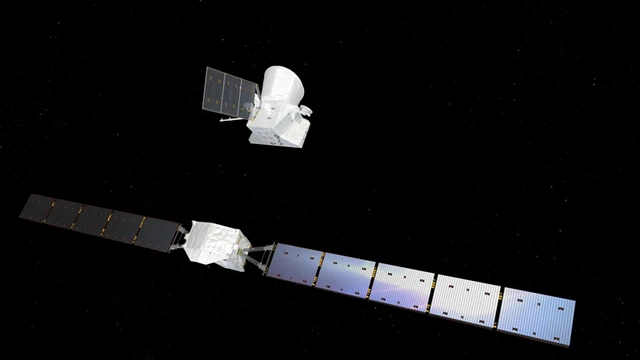 BepiColombo’s Odyssey: At the Threshold of the Sun