The center of our galaxy remains one of the most enigmatic realms of the cosmos—a place where the laws of physics are pushed to their absolute limits. Unlocking the secrets of supermassive black holes requires observing the celestial bodies that venture closest to the event horizon. The discovery of star S301 provides an unprecedented window into the inner workings of Sagittarius A*. This star serves as a natural probe, enabling scientists to precisely map the fundamental characteristics of the gravitational behemoth lurking at the heart of the Milky Way.
Probing the nature of supermassive black holes requires instruments of exceptional precision and immense patience. In recent years, astronomers have utilized the GRAVITY instrument, mounted on the European Southern Observatory's Very Large Telescope (VLT), to monitor the stellar environment at the very center of the Galaxy. This work is akin to observing a complex cosmic ballet, where every movement is dictated by the colossal gravity of Sagittarius A*. In 2023, this monitoring led to the discovery of S301—a star whose trajectory proved far more radical than any of the black hole's previously known neighbors.
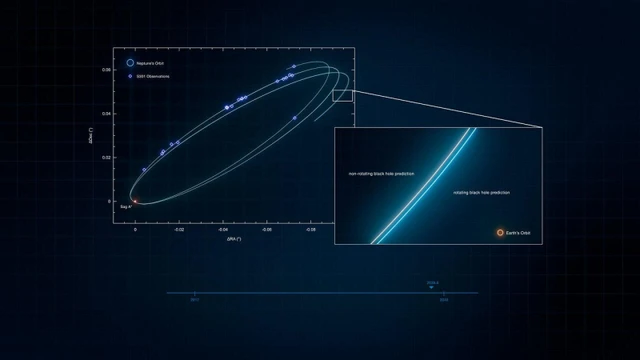
Data analysis reveals that S301 moves along a highly eccentric orbit, forming a severely elongated ellipse. In astrophysics, this geometry is described by eccentricity: while a perfect circle has a value of zero, the 0.9832 characteristic of S301 indicates a precarious state. The star is effectively teetering on the brink of escaping the gravitational grip of Sagittarius A*, completing a full orbit in just 8.7 years. This is three years faster than any other object in the region, making it a unique tool for probing the fabric of space-time.
The dynamics of S301's motion during its closest approach to the black hole are staggering. At the pericenter of its orbit, the star accelerates to 25,000 km/s, roughly 8% of the speed of light. At this point, S301 is ten times closer to the center of gravity than any other recorded star. The distance shrinks to 11 astronomical units—a scale comparable to Saturn's distance from the Sun, which, given the conditions at the Galactic center, represents an extreme proximity.
There is a delicate equilibrium between the star's mass and the tidal forces exerted by the black hole. S301 is approximately 1.5 times more massive than our Sun. Had it been larger, the gravitational gradient of Sagittarius A* would simply have shredded it, reducing the star to a stream of gas. It is likely that S301 entered such an eccentric orbit as the result of a dramatic event: it is hypothesized that the star was originally part of a binary system. Upon approaching the black hole, one component of the system was flung into the void, while S301 remained captive, condemned to an eternal plunge along its elongated trajectory.
From a scientific perspective, S301 serves as an ideal "precision instrument." Observing its motion over the next decade will allow astronomers to calculate the angular momentum of Sagittarius A* with high accuracy. This will pave the way for investigating more subtle aspects of black hole physics: from analyzing the object's deviations from a perfect sphere to searching for additional properties that influence its behavior. Thus, a single stray star becomes the key to unlocking the architecture of our galaxy's heart.
 Next-Generation Ultra-Lightweight Lens Technology