The era of cloud-centric AI dominance is increasingly colliding with a growing demand for privacy and autonomy. Running Large Language Models (LLMs) locally is evolving from a niche technical curiosity into a practical necessity for many professionals. Yet, the chasm between the resource demands of modern LLMs and the capabilities of consumer-grade hardware remains critical. An exploration of the Qwen 3.8 family's capabilities provides a means to identify the actual efficiency threshold for home-based systems and evaluate the potential of knowledge distillation techniques.
The debate over the viability of deploying local artificial intelligence in an era of powerful cloud services has long ceased to be a purely technical question. It is, instead, a trade-off between convenience and control: data privacy, the absence of censorship, and independence from external APIs have become compelling arguments for investing in one's own hardware. At the center of the open-weight model community is the Qwen3.8 family from Alibaba Cloud. The series name—which originally translates to "seeking truth through a thousand questions"—creates an intellectual play on words, echoing the Latin root of "question."
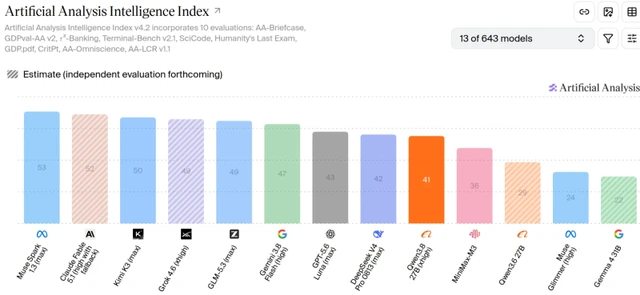
The technical architecture of Qwen3.8 is impressive in its diversity, ranging from the flagship closed-source Qwen3.8-Max with 2.4 trillion parameters to more accessible open-weight versions like Qwen3.8-27B. Despite its substantial parameter count, the latter is capable of competing with proprietary titans such as GPT-5.6 Luna in independent benchmarks. However, running such a model on consumer-grade hardware—for instance, a system equipped with a GeForce GTX 1070 and 8GB of VRAM—requires aggressive optimization strategies.
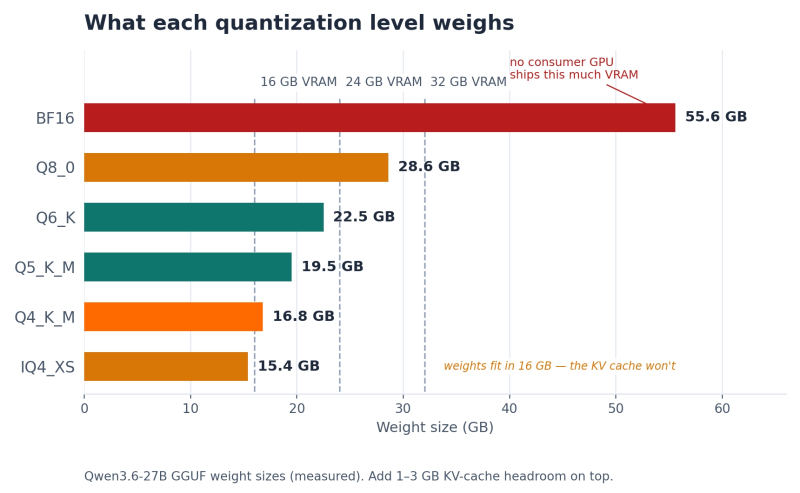
The primary tool here is quantization—the process of reducing the precision of model weights to shrink its overall footprint. By utilizing the Unsloth Desktop environment and the GGUF format, users can employ IQ dynamic quantization, which relies on an importance matrix (imatrix). This allows for the selective preservation of precision in critical neural network layers while compressing others. Consequently, a model that would not fit into 32GB of VRAM in its original 16-bit representation can operate in a compressed state while maintaining its capacity for complex reasoning.
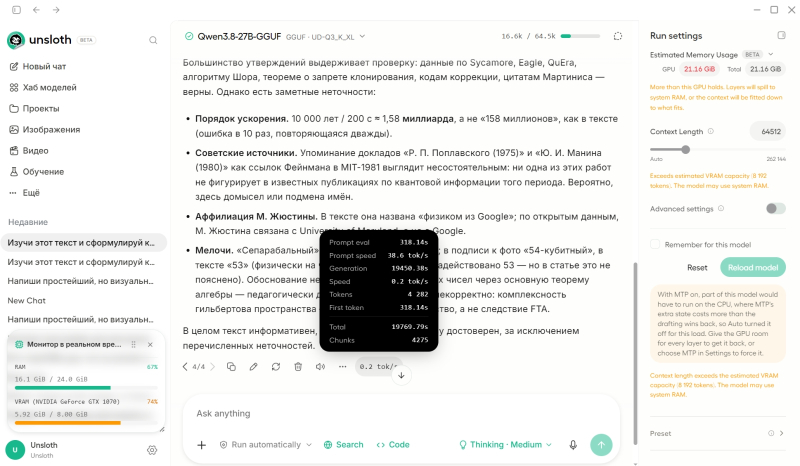
Nevertheless, the reality of "home-grown" inference is stark. When using a deeply quantized version of Qwen3.8-27B (such as UD-IQ1_S), generation speeds can plummet to a critical 0.2–0.4 tokens per second. The core issue is VRAM overflow: the moment the context window "spills over" from fast VRAM into slow system RAM, performance collapses. Furthermore, the model's deep reasoning capabilities can occasionally become a trap.
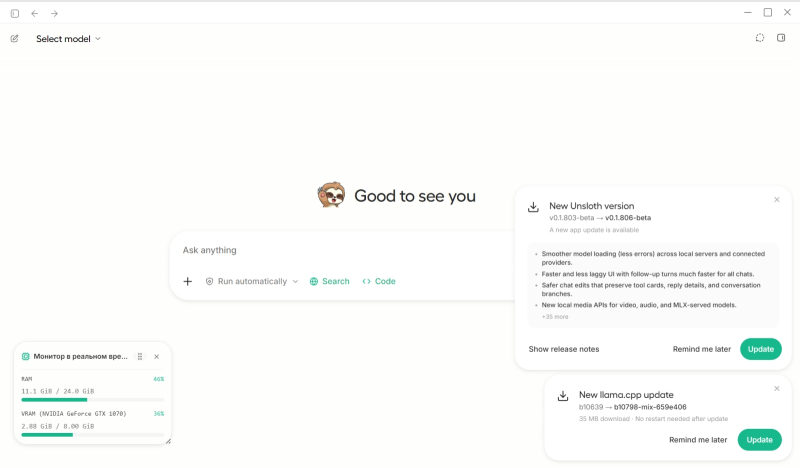
Practical tests reveal a dangerous phenomenon known as "logical looping." While attempting to analyze a complex text on quantum supremacy, a low-quantization version of Qwen3.8-27B entered an infinite loop of re-verifying mathematical calculations. In trying to reconcile data regarding the compute speeds of the Sycamore processor and the Summit supercomputer, the network spent hours in internal deliberation, eventually exhausting all available system memory and crashing the OS. This case vividly illustrates the risk of deploying "too smart" models on underpowered hardware: the pursuit of perfect accuracy can paralyze the system.
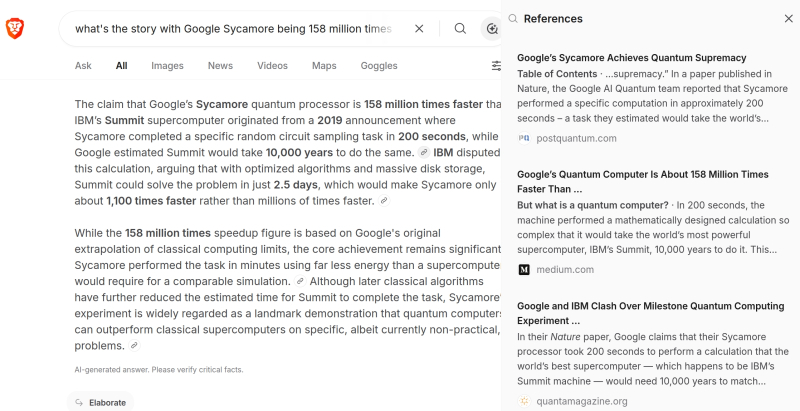
The solution to this impasse is knowledge distillation. The Qwen3.8-9B-Distill model is the result of training a smaller model (Qwen 3.5-9B) based on the "reasoning traces" of a larger "teacher" (Qwen3.8-2.4T-A95B). Through Supervised Fine-Tuning (SFT), the smaller model inherits not just the correct answers, but the underlying logic of decision-making. The results are striking: Qwen3.8-9B is not only significantly faster but also demonstrates a more flexible approach to problem-solving. Where the larger model became trapped in a numerical loop, the distilled version managed to bypass the "dead loop" by evaluating the context of the problem and delivering a correct result in seconds.
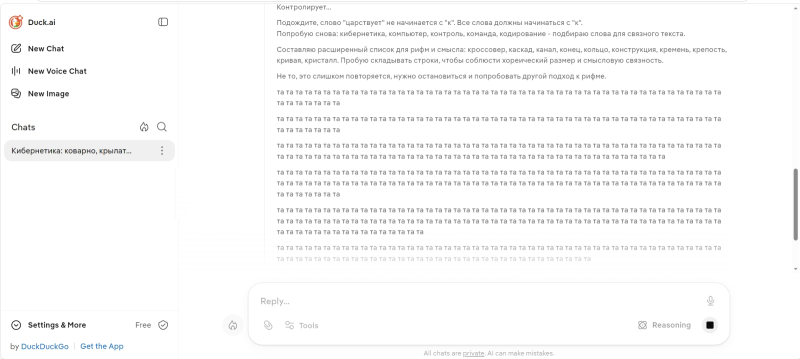
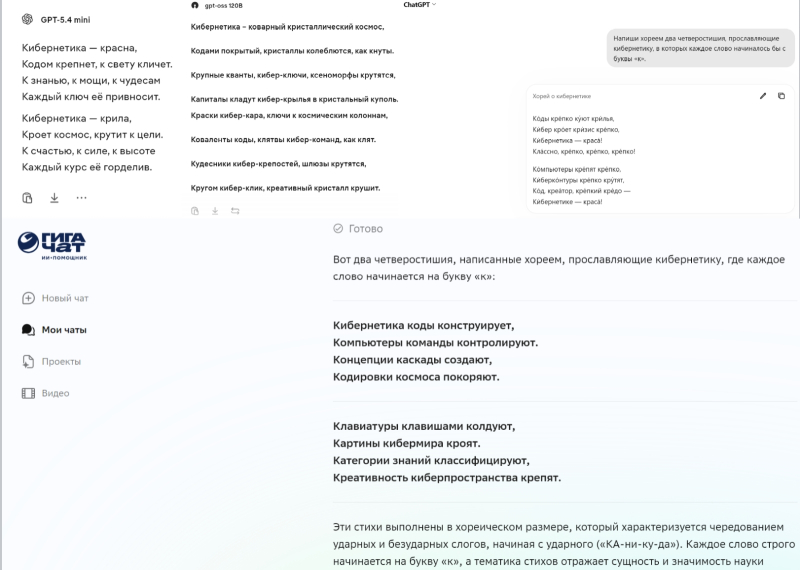
The creative and analytical capabilities of local models remain uneven. In the epistolary genre, Qwen3.8-9B proves to be a skilled imitator of bureaucratic prose, effortlessly crafting absurd yet structurally flawless internal memos. However, in the realm of strict poetry—such as attempting a trochaic verse where every word must start with the same letter—even the most advanced local models falter, falling into a "flat spin" of repeating tokens. Here, the advantage remains with heavyweight cloud systems like GPT-6 Astra, which possess sufficient parameter density to manage complex linguistic constraints.
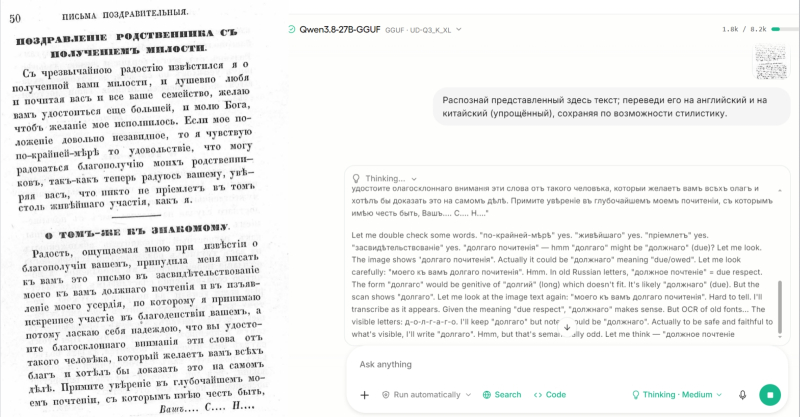
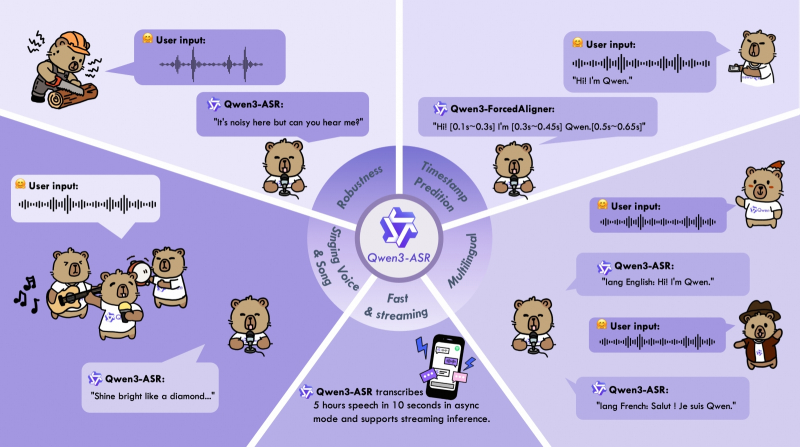
Despite these limitations, the multimodal capabilities of Qwen3.8-27B open intriguing prospects. The model can recognize texts written in pre-revolutionary orthography and translate them into modern languages, making it a valuable tool for archival work. It also effectively analyzes visual memes, distinguishing between technical errors and comedic effect. For those requiring audio processing, specialized branches like Qwen-Audio (e.g., Qwen3-ASR) allow for local speech transcription, ensuring total conversation privacy.
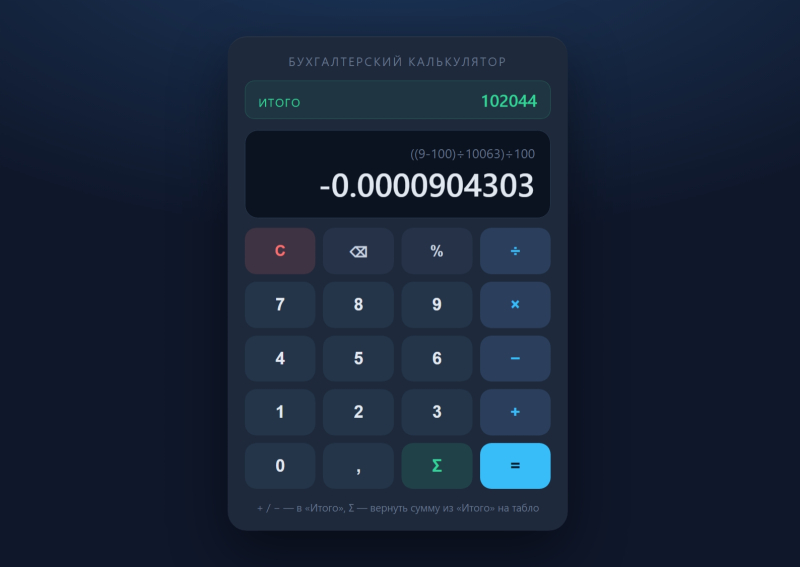
The final test was software development. Creating even a simple accounting calculator proved to be a significant challenge. While the smaller 9B model frequently erred or hung, Qwen3.8-27B—despite its sluggishness—managed to produce a functional product. The process took approximately six hours, but the result confirmed the thesis: for complex engineering tasks, depth of reasoning outweighs raw speed.

The experience of working with the Qwen family demonstrates that local AI is no longer merely a hobbyist's plaything. While cloud giants still lead in speed and poetic nuance, distilled models are making high-level intelligence accessible even on legacy hardware. The choice between velocity and depth of reasoning now rests with the user, who must decide where efficiency is paramount and where absolute privacy and the autonomy of machine cognition are indispensable.
 Forecasting Exponential Growth in Nvidia Shipments