Modern displays have reached an era of unprecedented clarity, yet blue remains their most stubborn technological bottleneck. The high excitation energy required for blue OLED pixels renders them inherently less durable and power-efficient than their red and green counterparts. For decades, addressing this deficiency necessitated costly empirical experimentation and the synthesis of increasingly complex chemical compounds. Now, the synergy between machine learning and quantum chemistry is unlocking a path toward next-generation materials that are not only cost-effective but also exceptionally bright and stable.
The "blue gap" in organic light-emitting diodes (OLEDs) has long stood as a quintessential challenge in materials science. While red and green subpixels operate with high efficiency, blue components require significantly higher excitation energies. This disparity leads to accelerated material degradation and a drop in overall device efficiency, making the quest for a stable, cost-effective blue emitter a top priority for the visual technology industry.
The traditional approach to developing efficient OLEDs relies on materials featuring Thermally Activated Delayed Fluorescence (TADF). In conventional fluorescence, light is emitted only from singlet excited states, which account for roughly 25% of all generated excitons; the remaining 75% of energy is lost as waste heat through triplet states. TADF technology effectively "forces" these triplets to emit light, reclaiming that energy for the visible spectrum. However, most such materials have historically relied on boron-based scaffolds, the synthesis of which remains a laborious and expensive process.
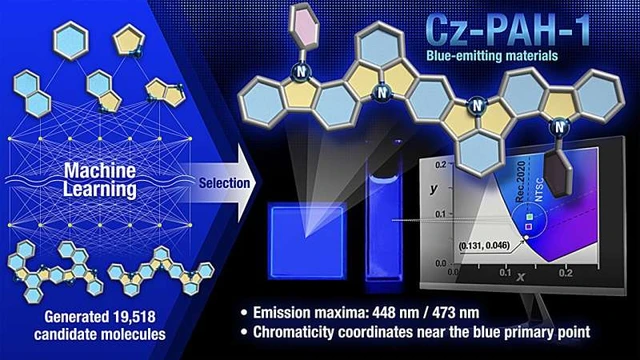
Researchers from Nagoya and Kyushu Universities in Japan have proposed a fundamental paradigm shift, replacing boron with compounds composed of carbon, hydrogen, and nitrogen. To bypass the endless cycle of trial-and-error typical of laboratory research, the team deployed a sophisticated intelligent discovery pipeline. They began by creating a virtual library of over 19,000 potential molecules. Since performing full quantum chemical calculations for every candidate would be computationally prohibitive, the team employed a selective learning strategy: 1,000 random molecules were analyzed in detail, and this dataset was used to train a machine learning model.
The AI acted as a high-throughput filter, independently evaluating the remaining 17,000 structures. From this pool, the system identified the 50 most promising candidates, which then underwent secondary verification via quantum chemistry methods. Ultimately, two molecules—Cz-PAH-1 and Cz-PAH-2—were selected for physical synthesis. This methodology reduced the number of high-precision calculations from 19,000 to just one thousand, drastically optimizing both the time and financial costs of the research.
The results are impressive. Both new materials demonstrated narrow-band blue emission with a full width at half maximum (FWHM) of only 17–19 nm. In the world of displays, this translates to exceptional color purity and high saturation. The photoluminescence quantum yield in thin films reached 93–99%, signifying an almost total absence of energy loss during light emission.
The efficiency metrics are particularly noteworthy: a pixel based on Cz-PAH-1 closely approached the stringent requirements of the Rec. 2020 ultra-high-definition standard, while the Cz-PAH-2 variant achieved a maximum external quantum efficiency (EQE) of 35.2%.
The significance of this breakthrough extends far beyond the OLED panel market. The cycle developed by the researchers—from molecular structure generation and AI filtering to synthesis and final testing—serves as a universal blueprint for modern materials science. This methodology can be scaled to discover new battery electrolytes, high-efficiency catalysts, or advanced solar cell materials, transforming the search for new substances from a matter of serendipity into a predictable engineering process.
 The Triumph of 3nm Chip Manufacturing