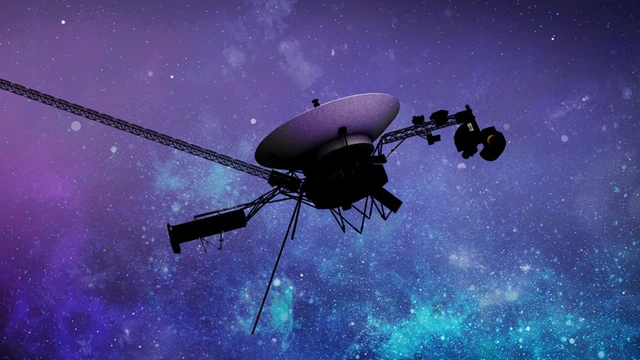
Humanity launched emissaries that became the first in history to breach the boundary of the heliosphere and venture into the stark vacuum of interstellar space. Yet, time and the laws of physics are relentless: the radioisotope thermoelectric generators (RTGs) powering the Voyager probes are slowly decaying, transforming the mission into a desperate struggle for every remaining watt. At this critical juncture, NASA engineers have initiated Operation "Big Bang" in an attempt to wrest additional months of operational life from entropy. This effort centers on the meticulous fine-tuning of power consumption for a spacecraft that remains our only instrument capable of directly measuring the environment beyond the reach of the solar wind.
The struggle for Voyager 2’s survival is ultimately a battle against fundamental physics. The probe's power core consists of three radioisotope thermoelectric generators (RTGs), which convert the heat generated by the natural decay of plutonium-238 into electrical current. Over the decades, the efficiency of this process has steadily declined; due to radioactive decay and the degradation of the thermocouples, the spacecraft's power output drops by approximately 4 watts every year. Having flown for decades, the probe's power budget has been depleted to a critical threshold, forcing engineers to deactivate nearly all non-essential systems and several heaters.
"Operation Big Bang" was conceived as a strategic response to this crisis. The maneuver involved the simultaneous shutdown of several energy-intensive devices, replacing them with leaner, more efficient alternatives. This optimization reclaimed a critical margin of power, effectively extending the operational lifespan of the three remaining scientific instruments by at least one year beyond their projected limit. Without this intervention, NASA would have been forced to sacrifice another sensor before the end of 2026.
Currently, Voyager 2’s scientific potential is concentrated in three primary complexes: the MAG magnetometer, the PWS plasma wave subsystem, and the CRS cosmic ray detector. Each serves a unique purpose. MAG analyzes the strength and vector of the interstellar magnetic field; PWS records plasma oscillations to estimate the density of charged particles; and CRS investigates fluxes of high-energy electrons and atomic nuclei. Previously, in September 2024 and March 2025, engineers were compelled to disable the direct plasma measurement instrument and the low-energy particle detector to maintain overall system viability.
Similar power management maneuvers are planned for Voyager 1, which is positioned even further from Earth. Both spacecraft, launched in 1977, have long since evolved from mere probes into technological artifacts. Voyager 1 exited the heliosphere in 2012, followed by Voyager 2 in 2018. Their enduring value lies in the fact that they are the only objects capable of transmitting data from a region where the influence of the solar wind gives way to the galactic environment.
However, executing these commands has become a genuine engineering feat. Managing a probe at the edge of the solar system involves staggering latency: a one-way signal takes approximately 24 hours, meaning a response to any command is not expected for two days. Under these conditions, maintaining thermal equilibrium is critical to prevent the electronics from succumbing to the absolute cold of deep space.
The situation is further complicated by the fact that the spacecraft's software was written in languages and according to standards long since deprecated in the modern industry. With most of the original project developers now gone, contemporary engineers must reverse-engineer the system logic almost from scratch, relying on archival documentation. The ability of the Voyagers to function after nearly half a century in flight is an achievement comparable in scale to the triumph of Sputnik. The only remaining constraint is the half-life of the fuel: had carbon-14, with its 6,000-year cycle, been used as the power source, the probes could have remained fully operational for the entire journey to Alpha Centauri.
 Breaking the Lithography Barrier in China