The trajectory of electric vehicle evolution is pivoting: the industry is moving away from a brute-force pursuit of battery capacity toward a sophisticated battle for the absolute efficiency of every single kilowatt. In a market where range has evolved from a luxury into a baseline requirement, the true benchmark of technological superiority is now defined by minimal energy consumption per unit of distance. The new record set by the GAC Aion RT proves that the frontier of feasibility in the mass-market segment extends far beyond previous assumptions. This milestone heralds a paradigm shift in engineering optimization, where efficiency itself becomes the ultimate competitive advantage.
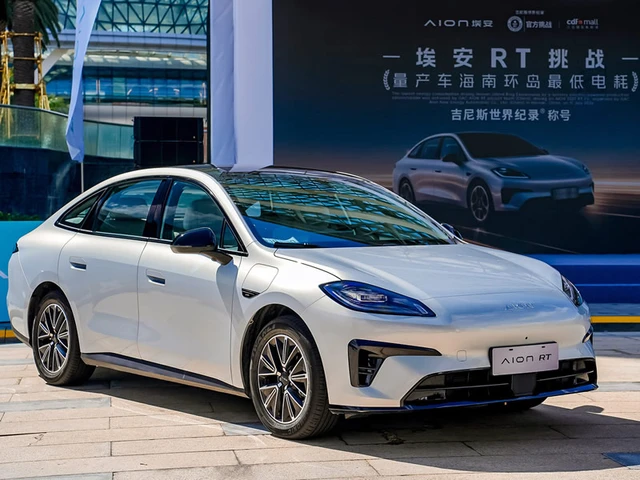
For too long, the electric vehicle industry has been dominated by the paradigm of "bigger battery, greater range." However, the real frontier of innovation lies in radically reducing the energy consumption of the vehicle itself. This is precisely the trajectory chosen by the GAC Aion RT. The sedan, slated for market release in August 2027, has officially set a world record for minimum energy consumption. During trials on coastal routes in Hainan Province, the vehicle achieved a result of 8.571 kWh per 100 km—a feat verified by Guinness World Records experts.
To put this achievement into perspective, one only needs to look at current industry benchmarks. The Tesla Model 3, widely regarded as one of the most efficient EVs globally, typically demonstrates consumption in the range of 12–14 kWh per 100 km. Even the Lucid Air, despite its cutting-edge powertrains and streamlined silhouette, consumes approximately 14 kWh when maintaining a constant speed. The Aion RT has not only surpassed these figures but did so over a real-world route spanning 400 miles (approximately 643 km), eliminating the anomalies often found in short-burst laboratory tests.
This result is the product of a convergence of several critical factors: an ultra-low drag coefficient, meticulous component weight optimization, and the deployment of high-efficiency inverters and electric motors designed for minimal thermal loss. While the full technical specifications remain closely guarded, it is evident that GAC's engineers have found an optimal equilibrium between vehicle mass and powertrain efficiency.
The choice of Hainan as the proving ground for this record is deeply symbolic. The province is evolving into a "living laboratory" for the energy transition; by 2030, the sale of internal combustion engine vehicles there will be completely banned. This ambitious government strategy aims to push EV market share to 45% and beyond, supported by an aggressive rollout of charging infrastructure and a systemic shift toward renewable energy sources.
From an economic standpoint, the success of the Aion RT could trigger a significant shift in market dynamics. Earlier iterations of the model were positioned at highly accessible price points—approximately $14,000. If the 2027 version remains within a comparable range, the market will gain a tool that outperforms premium solutions from Tesla and Lucid in efficiency while remaining available to the mass consumer. This poses a challenging question for the competition: is it necessary to keep increasing battery capacity if you can drastically reduce the vehicle's energy appetite?
 The Return of the Modular Era: Acer Vero 16