The quest to unravel the fundamental mysteries of cosmic expansion and the enigmatic nature of dark energy is entering a transformative new era. The Nancy Grace Roman Space Telescope is far more than just another instrument; it is a wide-field "eye" engineered to survey vast swaths of the deep cosmos. The observatory is currently in transit to the L2 Lagrange point, a strategic position designed to maximize its distance from terrestrial interference and mitigate thermal noise. Initial telemetry confirms that systems are awakening as planned, paving the way for a paradigm shift in our understanding of exoplanets and the architecture of galactic structures.
The journey toward a true understanding of the cosmos begins with the mastery of distance. Following its launch on August 30, the Nancy Grace Roman Space Telescope set course for the L2 Lagrange point—the gravitational equilibrium of the Sun-Earth system, located 1.5 million kilometers away. This remote outpost is critical for the operation of infrared instruments, as it allows the observatory to maintain a stable orientation while shielding its sensors from the blinding glare of the Earth and the Moon. While the spacecraft is in its three-month transit, engineers have begun the most critical phase: the phased activation of onboard systems.
The first system to come online was the Wide Field Instrument (WFI), a wide-angle infrared camera whose specifications are staggering in scale. With a resolution of approximately 300 megapixels and an array of 18 detectors—the total area of which is comparable to a modern laptop screen—the WFI leaves consumer smartphone sensors far in the dust. However, managing such a massive sensor array requires surgical precision in thermal control.
The activation process resembled a complex thermal choreography: first, the sensors were warmed to −65°C for about ten days to naturally purge residual moisture and contaminants accumulated during launch. This was followed by a sharp plunge to −143°C to activate the matrices. Ultimately, the instrument's operating temperature must reach −183°C; this extreme cold is essential to suppress the sensors' own thermal emission, which would otherwise drown out the faint signals emanating from the depths of space.
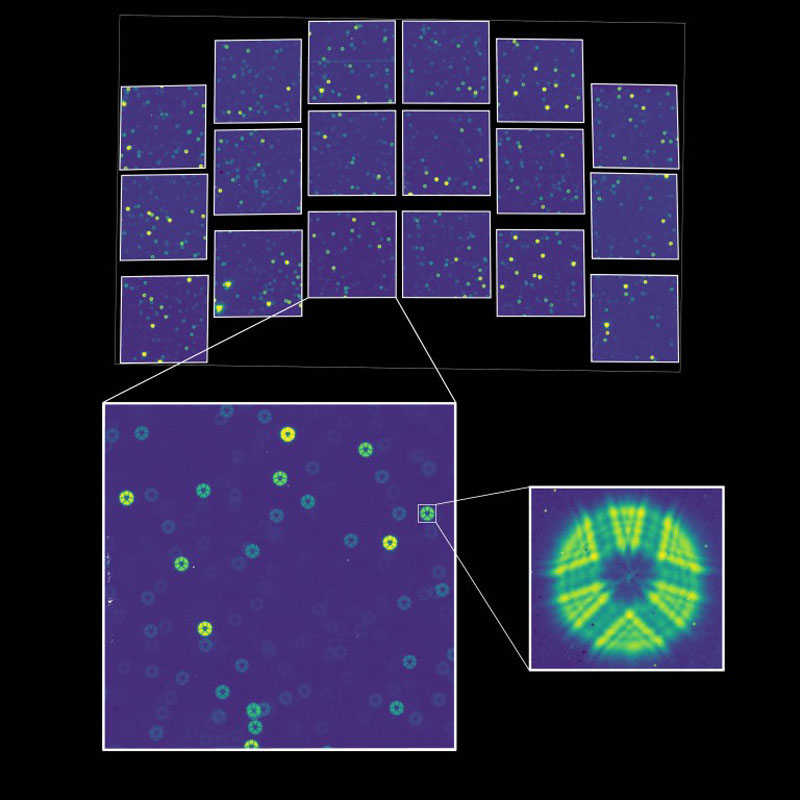
The first test image of a star field has already been received, and while it appears blurred, this is expected at this stage. The optics have not yet undergone final alignment, and the focus has not been calibrated. For the engineering team, this frame was less a scientific discovery and more a confirmation of the system's "viability." Now that the functionality of the detectors, filter-wheel mechanisms, and focusing systems has been verified, a months-long calibration process begins. Once this phase concludes in early 2027, the WFI will begin scanning the sky with unprecedented speed, mapping the distribution of galaxies and shedding light on the nature of dark matter and dark energy.
Parallel to the primary camera, the Coronagraph Instrument—designed for the direct imaging of exoplanets—is undergoing verification. The coronagraph's task is akin to spotting a firefly hovering next to a powerful searchlight. To achieve this, it employs a sophisticated system of masks, mirrors, and deformable elements that physically suppress the blinding light of a star, allowing the instrument to capture the faint, reflected glow of orbiting planets. At present, the integrity of all electronic circuits, actuators, and software has been confirmed.
A notable achievement of the mission has been the optimization of fuel consumption during the initial phase. Thanks to prudent resource management, the observatory's projected operational lifespan may be extended from ten to twelve or more years. In the realm of astrophysics, such an extension is an invaluable asset, enabling the collection of far more representative statistics on exoplanets and the dynamics of the universe's expansion.
In essence, the Nancy Grace Roman telescope serves as a bridge between the high-resolution, narrow-field observations of the James Webb Space Telescope and wide-area sky surveys. We stand on the threshold of an era where cosmology is transitioning from hypothesis to precision measurement, and the first signals from deep space confirm that the instrument is ready for the challenge.
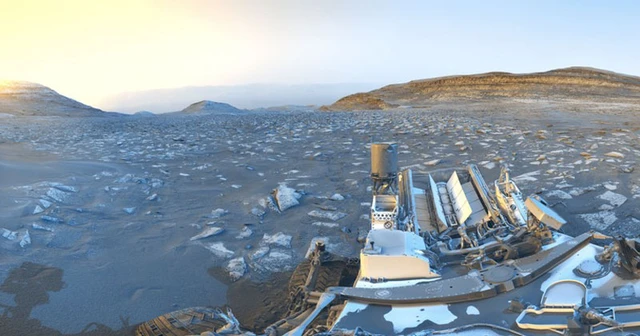 The 5,000-Day Milestone of Martian Exploration