The search for extraterrestrial life is shifting from the realm of theoretical hypothesis into the domain of rigorous empirical data. For decades, astronomers have pursued an "Earth twin"—a rocky world with a dense atmosphere orbiting within its star's habitable zone. The discovery of LHS 1140 b marks a watershed moment in this quest for knowledge; science now possesses its first compelling evidence that terrestrial conditions can indeed exist beyond the confines of our own solar system.
In modern astrophysics, the detection of exoplanets has long since transitioned into a routine endeavor; catalogs now list over 6,000 worlds. However, the true challenge has never been the mere fact of their existence, but rather their qualitative characteristics. The majority of discovered objects are either gas giants or entirely devoid of atmospheres, rendering them inhospitable to life as we understand it. The detection of an atmosphere on the rocky planet LHS 1140 b represents a paradigm shift, providing scientists with a concrete target for rigorous analysis.
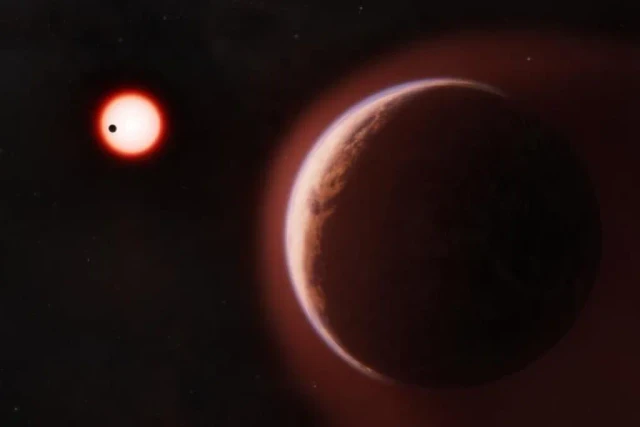
Located 48 light-years away, LHS 1140 b orbits a red dwarf—a star significantly smaller and cooler than our Sun. The critical factor here is the planet's position within the so-called "habitable zone." This narrow thermal corridor provides the precise conditions necessary for water to exist in liquid form: the planet is neither too close to its host star for oceans to boil away, nor too distant for them to freeze into eternal ice.
At the current stage of research, helium has been identified in the atmosphere of LHS 1140 b. While this gas is not a biomarker and cannot support biological processes on its own, its presence is fundamentally significant. It confirms the rocky world's capacity to retain a gaseous envelope, clearing the path for the search for more complex compounds—such as oxygen, nitrogen, or methane.
The history of the search for extraterrestrial life is fraught with dramatic revisions and sobering disappointments, which makes the progress with LHS 1140 b all the more valuable. Consider the case of K2-18b, a sub-Neptune world potentially harboring a water ocean. Previous reports regarding the detection of dimethyl sulfide—a gas produced on Earth exclusively by marine plankton—sparked immense excitement. However, a 2025 NASA re-analysis revealed that the signal was too weak for definitive confirmation and that the gas could potentially originate from abiotic processes.
A similar caution is being applied to the study of the TRAPPIST-1 system and its seven rocky planets. The James Webb Space Telescope has already allowed researchers to rule out an Earth-like atmosphere on TRAPPIST-1d, while data for TRAPPIST-1e remains ambiguous.
Consequently, LHS 1140 b emerges as one of the most promising candidates in the catalog of potentially habitable worlds. This discovery illustrates the evolution of astronomy: we have moved beyond the simple detection of celestial bodies toward a profound analysis of their chemical composition and climatic conditions. Each such step brings humanity closer to answering the ultimate question regarding our solitude in the universe.
 A Pragmatic Approach to Lunar Equipment Design