The universe possesses a recurring tendency to defy the established laws of astrophysics, unveiling objects that, by all conventional standards, simply should not exist. The discovery of exoplanets with exceptionally low densities is forcing a critical reassessment of contemporary models regarding the formation of planetary systems. Within the constellation Volans, astronomers have identified a singular duo of worlds—spheres whose composition is more akin to cotton candy than the familiar architecture of gas giants. This discovery marks the beginning of a new chapter in our understanding of stellar system evolution and the absolute thresholds of matter density in the cosmos.
Gas giants have long been viewed as the primary architects of their stellar systems. They are the forces that define the final configuration of planetary orbits, redistribute mass, and frequently sweep excess cosmic debris beyond the system's periphery to ensure long-term stability. However, the discovery of objects with anomalously low densities is beginning to disrupt these elegant hypotheses. Until now, catalogs listed no more than forty such "puffy" planets, but two new findings have set absolute records for lightness.
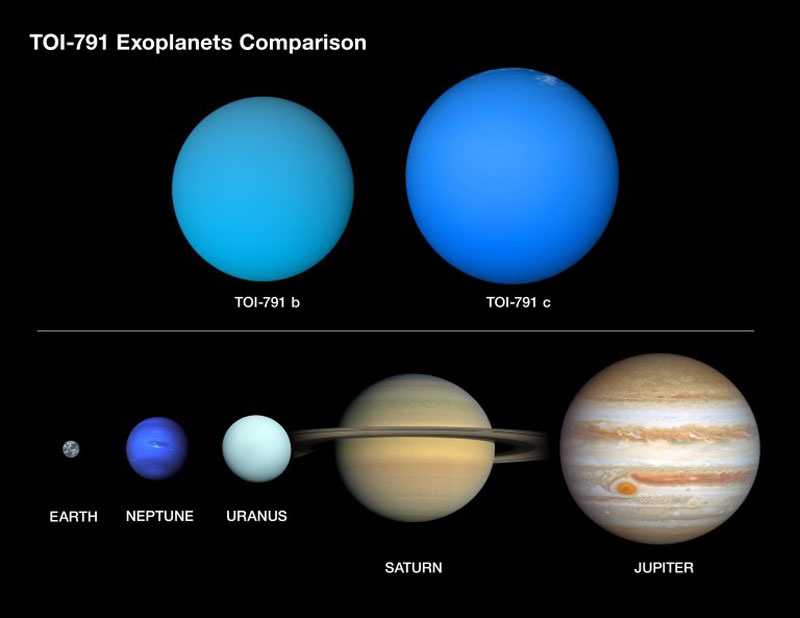
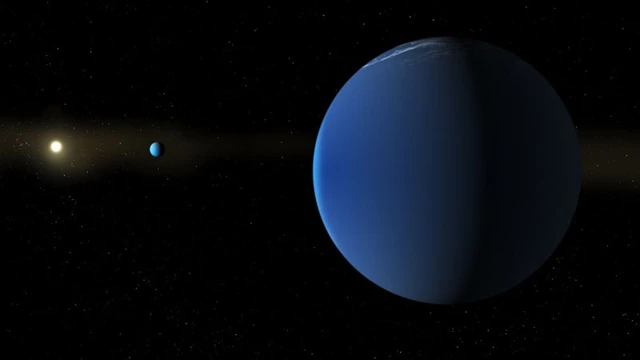
The discovery centers on the TOI-791 system, located approximately 1,110 to 1,113 light-years from Earth. The system's central star is an F7-type dwarf, whose characteristics closely mirror those of our own Sun. Orbiting this star are two enigmatic planets: TOI-791 b and TOI-791 c. While their physical dimensions are comparable to Jupiter, their masses are negligible by comparison.
The discovery was made using the transit method, with the TESS space observatory recording periodic dips in the star's brightness as the planets passed across its disk. Data analysis and subsequent modeling revealed staggering figures. TOI-791 b is nearly identical to Jupiter in size but possesses a mass of only 3% of Jupiter's—equivalent to roughly 9.5 Earth masses. Its companion, TOI-791 c, is even larger than Jupiter, yet its mass is a mere 5.9% of the gas giant's (approximately 18.7 Earth masses).
Consequently, the average density of these worlds is extraordinarily low: 0.038 g/cm³ for TOI-791 b and 0.047 g/cm³ for TOI-791 c. For context, Jupiter's density is dozens of times higher; the metrics of these new exoplanets are more akin to the density of cotton candy or raw cotton.
Beyond their composition, the orbital dynamics of these bodies are of particular interest. TOI-791 b has an orbital period of 139 days, while TOI-791 c takes 232 days. For transiting gas giants, such prolonged cycles pose a significant challenge for confirmation, as astronomers must record multiple transits across the stellar disk to verify the data.
To gather a sufficient dataset, TESS accumulated observations over 1,122 days spanning seven years. Ground-based observatories also played a critical role, specifically the ASTEP telescope at the Concordia Station in Antarctica. The unique conditions of the polar night allowed scientists to continuously track transits—which last over 11 hours for these planets—without the interruptions caused by daylight.
Determining the precise masses of these objects was made possible by their mutual gravitational influence. Because they share the same system, the planets exert gravitational pulls on one another, causing slight deviations in the timing of their transits. These Transit Timing Variations (TTVs) allowed researchers to calculate the mass of each body with high precision, confirming their incredible "puffiness."
Currently, the leading hypothesis suggests the presence of massive hydrogen-helium envelopes, which the planets may have accumulated in the cold regions of the protoplanetary disk during the early stages of their formation. However, this theory requires rigorous verification. The next phase of research is expected to utilize the James Webb Space Telescope (JWST), whose spectroscopic capabilities will allow scientists to probe the atmospheric composition of these ephemeral giants and uncover how nature forged such extraordinary worlds.
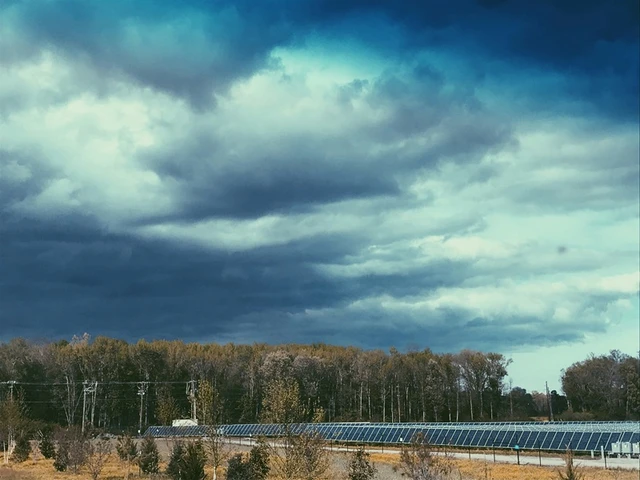 Drones for Cloud Cover Management Over Solar Power Plants