Urban logistics is on the precipice of a fundamental transformation, as traditional couriers are increasingly supplanted by autonomous aerial systems. Yet, the road to mass integration has hit an unforeseen bottleneck: the acoustic comfort of the urban landscape. While the industry remains preoccupied with optimizing payload and velocity, noise pollution is emerging as the primary benchmark for social acceptability. In this race, the ultimate victor will not be the fastest operator, but the quietest.
In the electric aviation industry, there is a critical psychological nuance: air taxi developers can benchmark their aircraft against traditional helicopters, meaning any noise reduction is viewed as an absolute win. Delivery drone creators, however, lack such a baseline. They are working from a blank slate, acutely aware that thousands of buzzing devices overhead could trigger a visceral public backlash.
Today, this challenge is shifting from theoretical discourse to the realm of cutthroat market competition. Industry titans like Amazon, Wing, and Zipline have already charted ambitious expansion paths. Amazon aims to penetrate hundreds of US cities; Zipline, backed by Uber, targets a million daily flights by 2029; and Wing expects to serve tens of millions of Walmart customers. However, the engineering excellence of these systems is no longer measured solely in kilograms and kilometers, but in decibels.
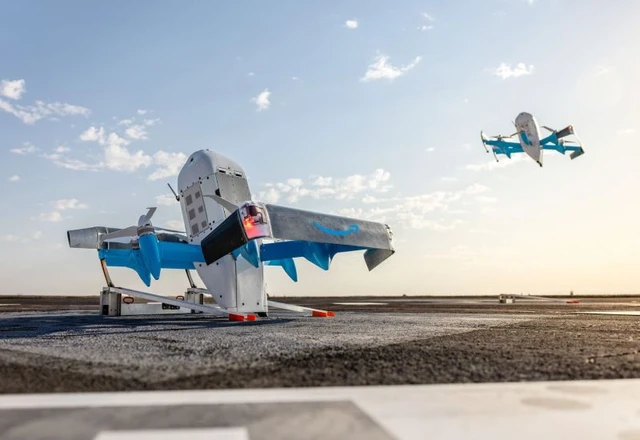
The heavyweight of this class is the Amazon MK30. Weighing nearly 36 kg with a payload capacity of 2.3 kg, this aircraft is a powerhouse of logistics, capable of reaching speeds of 117 km/h. Its defining feature is a hybrid flight profile: vertical takeoff transitioning into horizontal flight with rotors aligned parallel to the ground. Yet, herein lies the primary flaw—the delivery mechanism. The package is dropped from a height of just four meters, inevitably bringing the noise source closer to the recipient and placing higher demands on the package's protective cushioning.
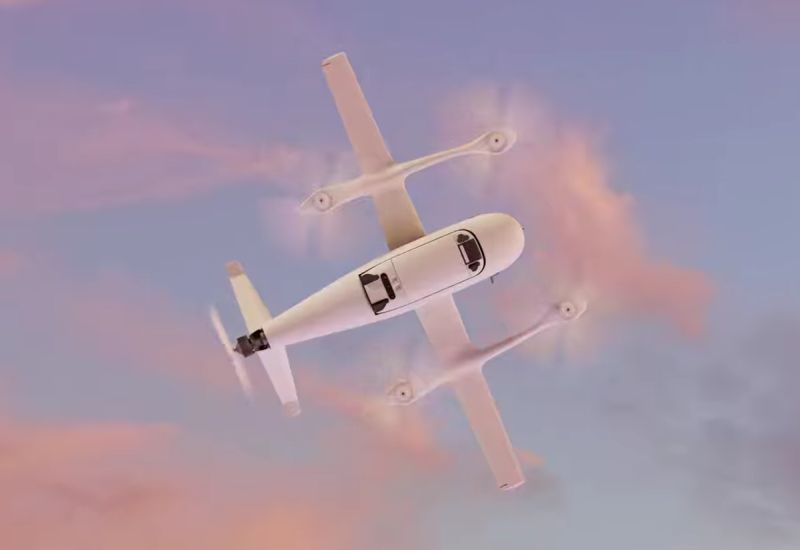
Zipline proposes a fundamentally different engineering paradigm with its Platform 2. This is essentially a "carrier" aircraft with a wingspan exceeding 2.4 meters, housing a compact delivery drone within. The system operates on a principle of functional separation: the primary aircraft hovers at 90 meters, remaining virtually imperceptible to those below, while the smaller drone descends via a tether for precision delivery. Once the operation is complete, the delivery module is retracted into the fuselage, and the system returns to base. This approach allows for payloads of over 3.6 kg over distances up to 16 km, while minimizing the acoustic footprint on the urban environment.
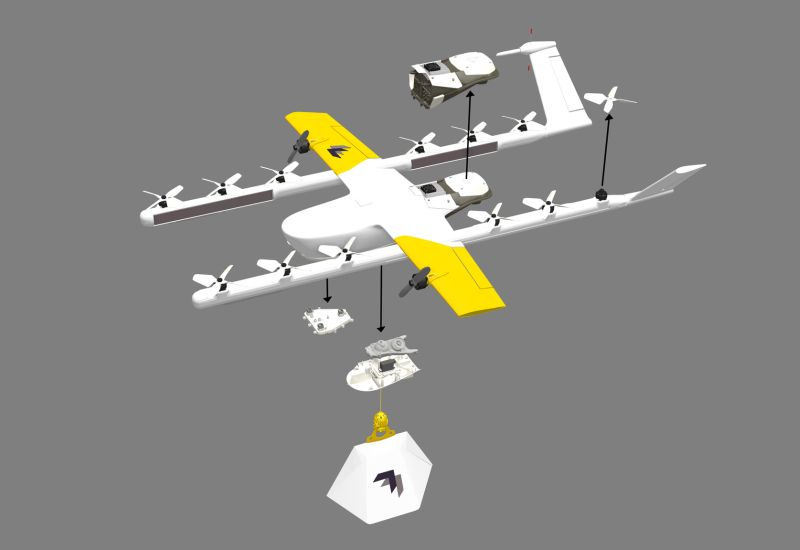
A third approach is embodied in Wing’s Hummingbird 8000-A. The lightest of the group at just 7.7 kg, it relies on distributed propulsion: 12 propellers, some mounted on the fuselage's longitudinal beams, facilitate vertical movement. The drone can deliver orders up to 2.3 kg over a range of 19 km. To mitigate noise pollution, Wing employs a remote drop method, lowering the cardboard container via a cable from a height of approximately 23 meters.
Comparative data from the Federal Aviation Administration (FAA) clearly illustrates how operational altitude affects noise perception. Zipline leads in acoustic comfort with a rating of 79 dB. Wing follows at 84 dB. The loudest is Amazon’s heavy-lift drone, which, due to its low-altitude delivery mode, generates a noise level of 88 dB at a distance of 15 meters.
Given the logarithmic scale of sound, the difference between 79 and 88 decibels is staggering. In a mass-deployment scenario, where city skies are filled with thousands of flights, the acoustic profile will become the deciding factor. Speed and payload capacity have already reached the necessary thresholds; the primary engineering challenge now is to create an "invisible," silent service that prevents urban life from devolving into an endless technological cacophony.
 The Global Triumph of Chinese Electric Mobility