The modern semiconductor industry is effectively held captive by a narrow oligopoly of lithography equipment suppliers. Access to Extreme Ultraviolet (EUV) technology has become the sole viable pathway for producing chips below the 7-nanometer threshold, transforming these machines into potent instruments of geopolitical leverage. Sidelined from this market since 2019, China is now aggressively pursuing total autonomy in the production of critical components. Recent breakthroughs by domestic researchers in developing a light source mark the beginning of a long and arduous journey toward breaking this technological dependency.
In modern microelectronics, the lithography scanner is something of a "Holy Grail." It defines the physical limits of transistor miniaturization, enabling the transfer of incredibly complex circuit topologies onto a silicon wafer. However, this market is characterized by an unprecedented concentration of power: virtually the entire world depends on a handful of Western companies, most notably the Netherlands-based ASML.
Producing chips at nodes below 7nm requires Extreme Ultraviolet (EUV) lithography. Unlike traditional Deep Ultraviolet (DUV), EUV utilizes a significantly shorter wavelength, allowing for finer lines and higher transistor density per unit area. Since 2019, shipments of these systems to China have been blocked by the Netherlands and the U.S., forcing Beijing into an urgent race to develop its own indigenous technological stack.
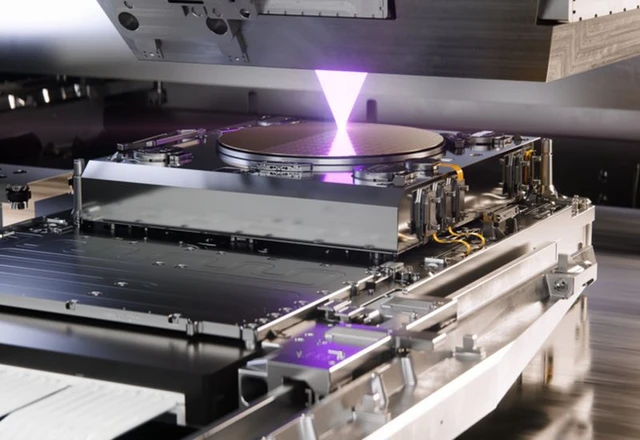
The critical component of any EUV system is the light source. For a long time, Chinese developments remained confined to laboratory experiments with dismal efficiency. Previous iterations demonstrated energy conversion efficiencies no higher than 3.42%, resulting in colossal energy losses during the process of generating usable radiation for silicon processing. Furthermore, the power output of these units fluctuated between 100–150 W—critically insufficient for industrial-scale application.
For comparison, ASML’s current production systems deliver approximately 600 W, with their next-generation roadmaps targeting a threshold of 1,000 W. In the semiconductor world, source power correlates directly with fab throughput: higher power means more wafers processed per hour and a lower cost per chip.
Progress in this arena has been driven by an influx of intellectual capital. A significant contribution to the development of the new light source came from a specialist with experience at ASML, who possessed a deep understanding of the internal mechanisms governing these laser systems. This highlights a broader trend: China's technological leap is fueled not only by state investment but also by the strategic poaching of key competencies from Western R&D centers.
However, creating a functional light source is merely one hurdle among many. A fully realized EUV scanner is one of the most complex engineering feats in human history. Beyond the laser, the system requires ultra-precision mirrors with near-perfect reflectivity (as conventional lenses absorb EUV rays), high-precision positioning actuators, and sophisticated software to orchestrate the entire process.
Currently, Chinese prototypes still struggle with suboptimal optics, rendering them unfit for mass production. Analysts believe that even with a functional light source, China will not be able to produce a fully operational and commercially viable homegrown EUV scanner until 2028–2030. This time lag creates a critical window of opportunity for Western firms, while simultaneously confirming Beijing's strategic resolve to completely eliminate external dependencies from its semiconductor supply chain.
 The Price of Acceleration: CXMT’s Rapid Push into Memory