The global transition toward renewable energy is confronting a fundamental hurdle: the inherent instability of power generation. Solar panels are dormant at night, and sudden cloud cover can trigger critical fluctuations across the grid. The solution lies in the development of hybrid complexes engineered for industrial-scale energy storage. A pioneering project in China now demonstrates how the synergy between photovoltaics and concentrated solar power can transform the sun into a stable, predictable, and reliable energy source.
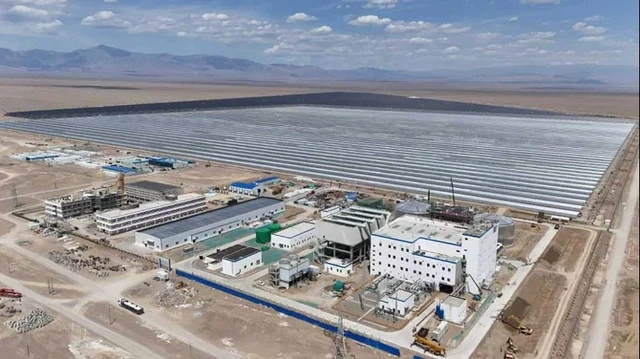
On the southern fringes of the Gobi Desert, near the city of Hami, one of the most ambitious energy ventures of the modern era has come to fruition. The state-owned China Three Gorges Corporation has commissioned a 1 GW hybrid solar power plant for pilot commercial operation. This complex is far more than a mere array of panels; it is a sophisticated engineering ecosystem designed to tackle the fundamental Achilles' heel of green energy: intermittency.
The plant's technical architecture is divided into two functional segments. The bulk of the generation is handled by 900 MW of conventional photovoltaic (PV) panels, optimized to capture the peak intensity of daytime insolation. However, the true technological heart of the complex is a 100 MW solar concentrator. Departing from traditional tower-based systems—where thousands of mirrors focus light onto a single point atop a high tower—this facility employs a horizontal configuration.
The thermal component is powered by Fresnel linear reflectors. Approximately 260,000 flat mirrors, equipped with a precision solar tracking system, form a massive reflective field spanning 800,000 square meters. These mirrors direct a concentrated stream of radiation onto stationary receiver pipes positioned directly above them.
The critical medium here is molten salt, which circulates through the pipes and is heated to 550°C. The salt serves a dual purpose: acting as both the heat transfer fluid and a high-efficiency energy storage medium. When the sun sets or cloud cover rolls in, the stored thermal energy is transferred to water, generating steam that drives a standard steam turbine and electrical generator. This configuration allows the plant to maintain full power output for up to eight hours after sunset, effectively transforming solar energy into a reliable baseload power source for the grid.
From an operational standpoint, the complex is engineered for maximum resilience. The concentrator field is partitioned into 46 independent loops, allowing for the maintenance of specific sections without shutting down the entire facility—a critical requirement for a project of this magnitude. Energy flows are managed by an automated system that regulates the contribution of the PV and thermal blocks with surgical precision. The system's response time is less than a second, and its current frequency stability reaches 0.02 Hz, performance metrics comparable to those of traditional thermal or nuclear power plants.
The scale of the project is staggering: the complex occupies over 1,800 hectares, with total investments reaching $480 million. The projected annual energy yield is estimated at 2.07 TWh, enough to power approximately 830,000 households. Within this balance, the solar concentrator alone is expected to contribute over 145 GWh annually.
This launch propels China to the forefront of hybrid generation, surpassing the total capacity of Dubai's Noor Energy 1 complex. Yet, the race for efficiency continues; another 1.5 GW plant utilizing tower concentrators is already being prepared for launch in the same region. The industry is clearly evolving, moving beyond simple solar farms toward the creation of comprehensive energy hubs capable of ensuring regional energy security 24/7.
 Navigating via Earth's Gravitational Anomalies