In an era of escalating climate volatility, the precision of meteorological forecasting has evolved from a scientific pursuit into a critical pillar of global security. Conventional physical models are increasingly being augmented by neural network architectures capable of synthesizing vast datasets in a matter of minutes. The latest iteration of the Aurora 1.5 model represents a paradigm shift in our understanding of atmospheric dynamics; by fusing deep learning with classical physics, it achieves unprecedented precision in tracking tropical cyclones and enhancing long-term strategic forecasting.
Weather forecasting has long remained one of the most formidable challenges in computational science, primarily due to the inherent chaos of atmospheric processes. For years, the gold standard was defined by the ensemble models of the European Centre for Medium-Range Weather Forecasts (ECMWF), which relied on intricate systems of differential equations. However, the arrival of Aurora 1.5 elevates this battle against chaos, introducing a paradigm shift rooted in big data analysis and machine learning.
The updated model has significantly expanded its analytical toolkit, incorporating 22 new meteorological variables. This is not merely a quantitative increase in data, but a qualitative leap in capability for critical economic sectors. For the energy industry, this translates to more precise planning for renewable energy generation; for agriculture, it means mitigating the risks of crop failure; and for transport logistics, it allows for the optimization of routes amidst extreme weather events.
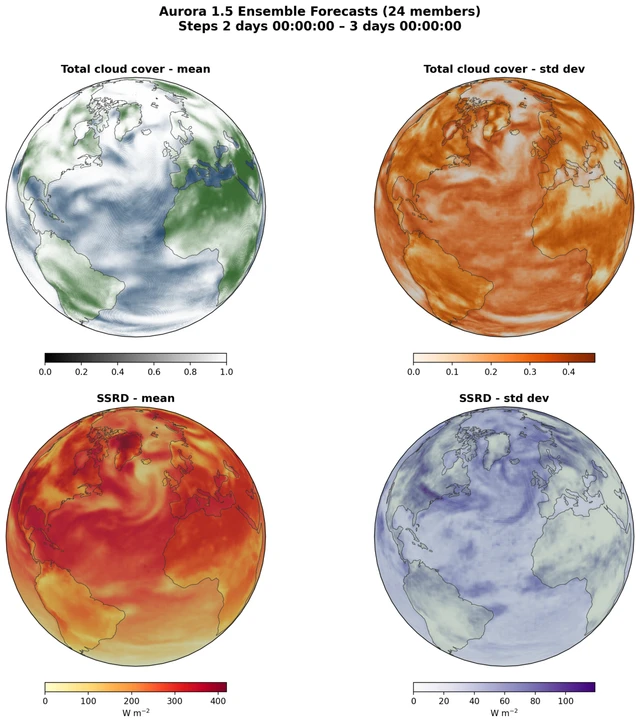
Aurora 1.5 places a particular emphasis on temporal resolution and a probabilistic framework. The shift to hourly data updates allows for the tracking of atmospheric dynamics with far greater granularity. Furthermore, the implementation of ensemble forecasting means the model no longer produces a single deterministic scenario, but instead generates a comprehensive spectrum of probabilities—a critical requirement for accurate risk assessment. According to internal benchmarks, Aurora 1.5 outperforms existing analogs across 88.9% of evaluated metrics.
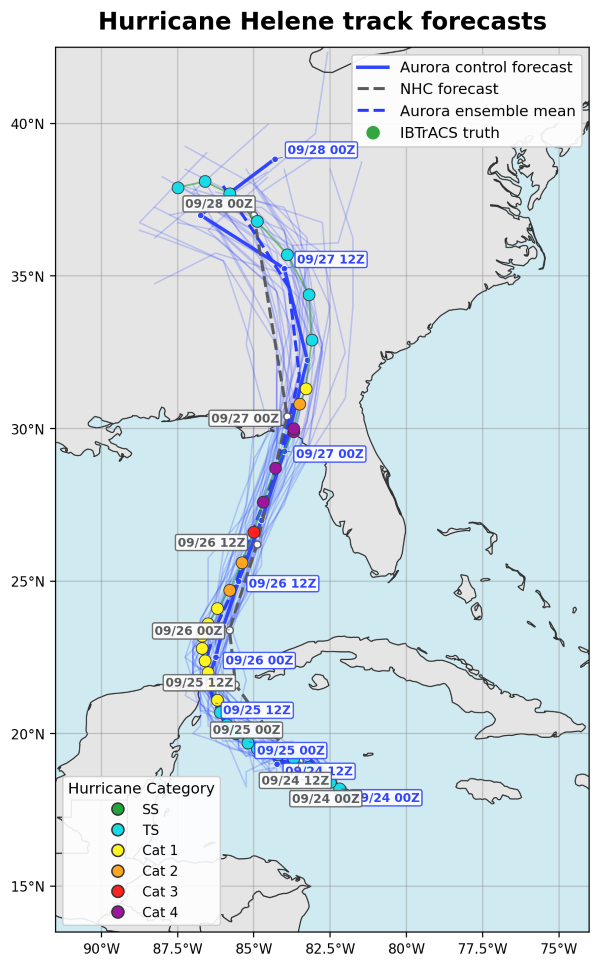
The most striking results are evident in the tracking of tropical cyclones. Using Hurricane Helene as a case study, it was demonstrated that utilizing the ensemble median reduced trajectory errors by one-third compared to the previous version of the model. Such precision is more than a technical achievement; it is a life-saving tool that enables more effective and timely evacuations from high-risk zones.
Nevertheless, the developers are maintaining a pragmatic stance. Despite the raw power of AI, the risk of "hallucinations" or the generation of physically impossible results persists. Consequently, Aurora 1.5 is positioned not as a replacement for traditional physico-mathematical models, but as a powerful engine of synergy. The most reliable forecasts today are built on a synthesis of data: when neural network computations complement the rigid laws of physics, the resulting output becomes maximally informative and dependable.
This trend is already manifesting at the state level. The National Oceanic and Atmospheric Administration (NOAA) has already integrated AI models into its operational workflows. Specifically, the AIGFS system—built upon Google DeepMind's GraphCast and fine-tuned on NOAA's proprietary datasets—demonstrates staggering computational efficiency. The model can generate a 16-day forecast in just 40 minutes, consuming a mere 0.3% of the resources required by the traditional GFS system.
The decision to make Aurora 1.5 open-source via GitHub opens new horizons for independent researchers and government agencies worldwide. Simultaneously, the technology will be integrated into commercial products, such as Microsoft Weather, bringing high-precision climate data to millions of users in real time.
 The Expansion of Semiconductor Foundry Giants