The meteoric rise of generative AI has ignited an unprecedented surge in demand for high-performance memory, transforming the semiconductor landscape into a theater of intense strategic competition. In a decisive response, Samsung is evolving its Pyeongtaek industrial cluster into the world's preeminent chip manufacturing hub. The accelerated rollout of new fabrication plants signals a shift toward aggressive expansion, a move designed to cement the company's technological hegemony for the next decade. The sheer scale of investment and the velocity of capacity deployment underscore a fundamental corporate bet on the long-term trajectory of AI infrastructure.
The memory industry has always been defined by extreme volatility, where missteps in capacity planning can lead to either catastrophic surpluses or acute shortages. In Pyeongtaek, Samsung has navigated this cycle firsthand: while the company was forced to cautiously commission the facilities of its massive complex a few years ago, its strategy has now shifted toward aggressive acceleration. Construction of the sixth fab is currently proceeding ahead of schedule, signaling the company's profound confidence in future demand.
The centerpiece of this current expansion is the P5 Fab 2 project. According to reports from South Korea, site work has entered an active phase; the arrival of piling rigs and the mobilization of equipment indicate that foundation work will commence within the coming month. Geodetic surveys are complete, and the management and technical teams have already been assembled.
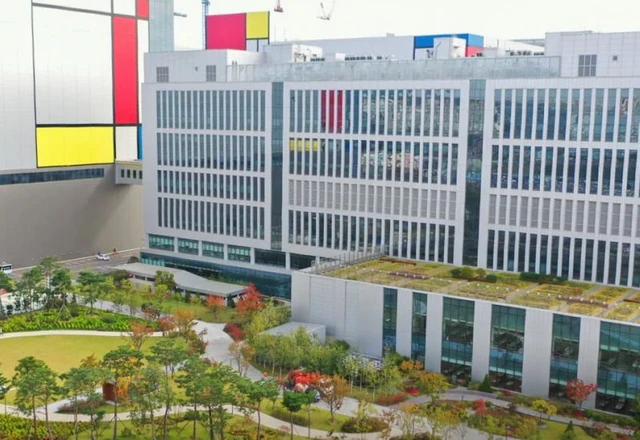
The scale of the facility is staggering: the building will cover approximately 130,000 square meters—roughly the size of eighteen football fields. The manufacturing process will utilize 300mm silicon wafers, enabling the plant to produce between 200,000 and 300,000 wafers per month. While the primary focus remains on HBM, DRAM, and NAND memory, the flexibility of the production lines will allow Samsung to accommodate logic component orders for third-party clients, thereby expanding its footprint in the contract manufacturing (foundry) segment.
P5 Fab 2 is expected to go online by 2029, six months ahead of original projections. This facility will complement the adjacent P5 Fab 1, which broke ground late last year and is slated for completion by 2028. Capital expenditures for each of these sites are estimated at approximately $39 billion. Together, the two plants will provide a combined capacity of up to 600,000 wafers per month.
When compared to Samsung's current DRAM output (roughly 650,000 wafers per month across all facilities), it becomes clear that the company is effectively doubling its production capacity by 2029. This is a strategic maneuver designed to secure dominance in the High Bandwidth Memory (HBM) segment—a critical component for modern AI accelerators.
However, this expansion extends beyond new shells in Pyeongtaek. Samsung is simultaneously modernizing existing lines. Specifically, the P4 fab is deploying 6th-generation 10nm DRAM production (1c) dedicated to HBM4 chips. This line will add another 100,000 to 200,000 wafers per month, ensuring a technological lead in storage density and power efficiency.
The company's global strategy spans other regions as well. In China, Samsung is scaling the production of ultra-dense 286-layer NAND, while in Taylor, Texas, preparations are underway for the launch of 2nm chip production, which will be highly sought after by giants such as Tesla.
Consequently, Samsung is constructing a multi-layered defense of its market position: from scaling quantitative volume in South Korea to mastering cutting-edge process nodes in the US and China. The increase in capital expenditures this year—though specific figures remain absent from official reports—confirms the company's intent to build an insurmountable barrier for its competitors through a combination of colossal scale and technological sophistication.
 The Economic Paradox of the GeForce RTX 5090