Space weather has long been the ultimate wildcard—a variable humanity has strove to quantify with absolute precision. For decades, the prevailing consensus was that Earth’s magnetosphere functioned as a natural buffer, mitigating the impact of the most violent solar flares. Yet, emerging research reveals a sobering truth: the so-called "saturation effect," long thought to shield the planet from catastrophic current surges, was nothing more than a statistical illusion. This revelation fundamentally reshapes our understanding of just how vulnerable we truly are in the face of extreme geomagnetic events.
For years, the prevailing paradigm regarding the interaction between the Sun and Earth was centered on the concept of a "saturation limit." Legacy models posited that the magnetosphere possessed a finite throughput capacity: once solar wind intensity hit a critical threshold, further increases in plasma flow yielded diminishing returns in terms of electrical currents surrounding the planet. This created a dangerous illusion of safety—the belief that even the most cataclysmic solar flare had a physical "ceiling" beyond which its impact could not escalate.
To test this hypothesis, researchers conducted an exhaustive analysis of data from the Wind spacecraft, which monitored solar wind parameters at the L1 Lagrange point from 1995 to 2019. Positioned approximately 230 Earth radii away, L1 serves as an ideal sentinel post, capturing plasma flows before they collide with the magnetosphere. However, this distance introduced significant variables: flow characteristics often shifted during transit, and inaccuracies in estimating arrival times and field strength could exceed 30%.
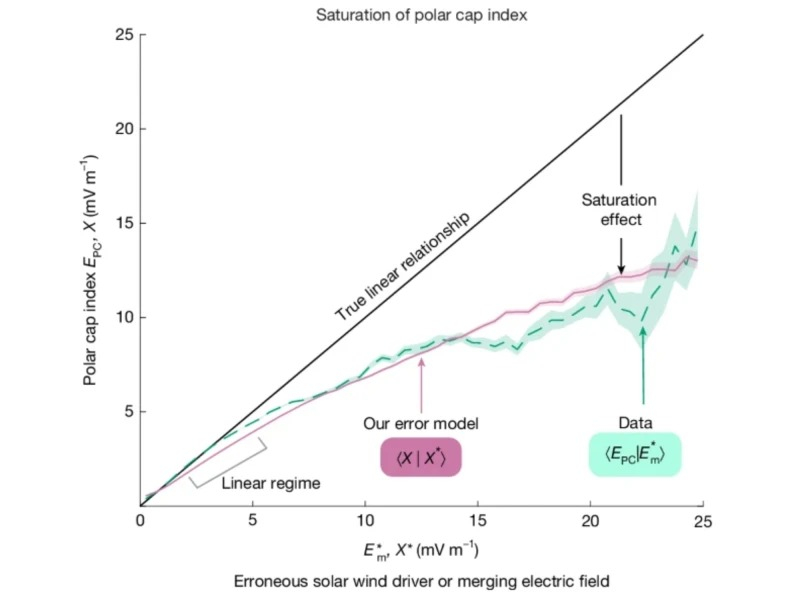
The breakthrough came via a novel computational approach that fully accounted for these systemic errors for the first time. By employing Monte Carlo simulations to model measurement inaccuracies and perform statistical data processing, researchers uncovered a startling reality: the "saturation" effect appeared only when errors were baked into the model. Once the statistical noise was stripped away, the correlation between solar wind intensity and the strength of geomagnetic storms on Earth proved to be nearly linear.
This implies that the magnetosphere does not attenuate impact energy as effectively as previously assumed. The research confirms a linear escalation in impact up to at least 15 mV/m. At a projected intensity of 25 mV/m, the resulting geomagnetic storm could be effectively twice as powerful as predicted by previous models.
This recalibration shifts the threat from a theoretical curiosity to a tangible risk for global infrastructure. We are no longer talking merely about vivid auroras, but about critical loads on terrestrial power grids, disruptions to satellite constellations, and the degradation of navigation and radio communication systems. History provides a precedent in the Carrington Event, where a massive flare ignited fires at telegraph stations; today’s world, tethered to microelectronics and GPS, is far more susceptible to such volatility.
While a reaction limit for the magnetosphere may still exist at extreme values, current observations have yet to identify a point where such a mechanism takes effect. The realization that we have underestimated the scale of potential impacts mandates a comprehensive overhaul of protection standards for critical infrastructure by engineers and government agencies. A miscalculation today could trigger a systemic collapse tomorrow; relying on the planet's "natural shielding" is no longer a viable strategy.
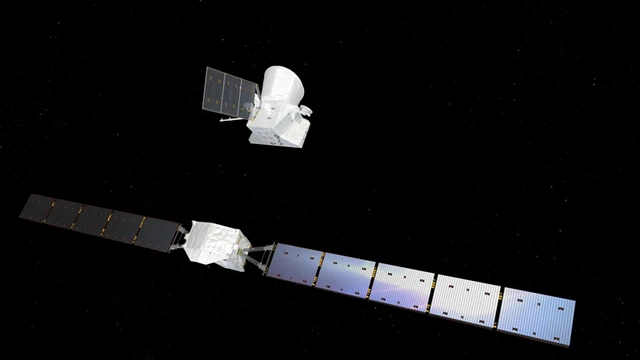 BepiColombo’s Odyssey: At the Threshold of the Sun