Space exploration frequently yields dividends in the most unexpected places. Even spent rocket stages and ballast weights can serve as instruments for rigorous scientific analysis. The accidental bombardment of the Martian surface by debris from the Perseverance lander's descent stage evolved into a unique planetary sounding experiment. This event enabled researchers to calibrate impact models with high precision and refine existing theories regarding the density of the Martian regolith.
In modern planetary science, there is a concept of "serendipitous science," where mission side effects or even technical glitches become sources of invaluable data. Previously, such methods helped researchers study lunar dust or analyze the contamination of Mars rover solar panels. However, the delivery of the Perseverance rover in 2021 elevated this approach to a new level, effectively transforming discarded structural elements into improvised geophysical probes.
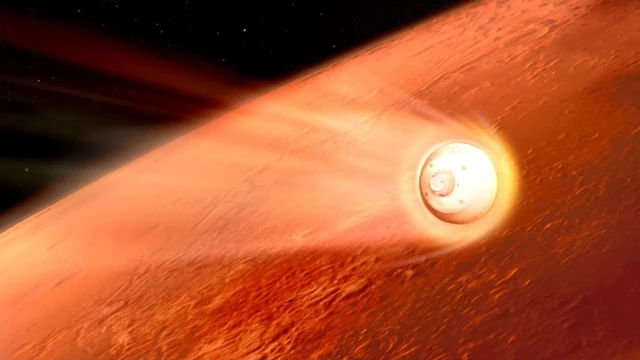
The mechanics of the process were swift and straightforward. At an altitude of approximately 1,300 km, two tungsten ballast weights, each weighing 77 kg, were jettisoned from the descent module. Later, fragments of the cruise stage, with a total mass of about 540 kg, struck the surface. These objects entered the atmosphere at a shallow angle of roughly 10 degrees, traveling at 4.7 km/s. This unintentional bombardment resulted in the formation of five distinct impact craters approximately 70 km northwest of Jezero Crater.
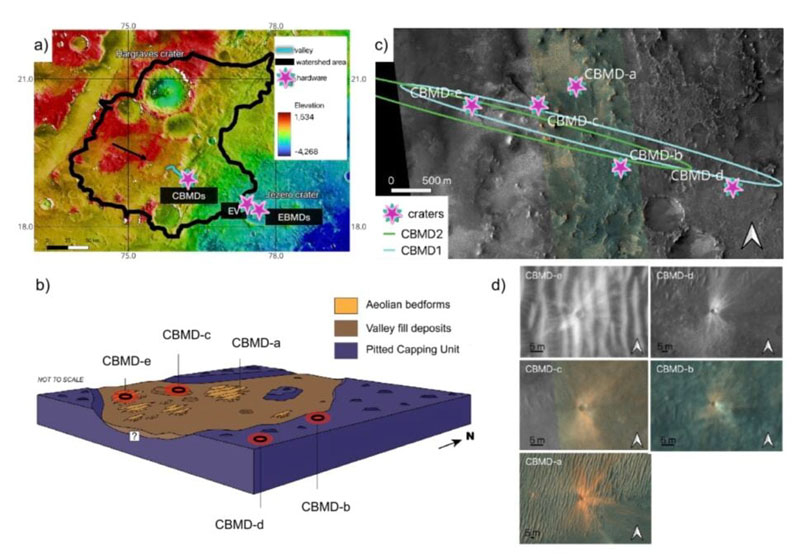
The scientific value of this event lies in the exceptional precision of the baseline data. In classical planetary science, crater analysis is complicated by the fact that the mass and composition of the impacting meteorite are typically unknown, forcing researchers to rely on probabilistic models. In this instance, however, the "projectiles'" parameters—their mass and material—are known with absolute certainty. This allowed researchers to treat the Martian surface as a laboratory for validating impact models that had previously been calibrated using terrestrial data.
The detection and analysis of these craters were made possible by the cameras aboard the Mars Reconnaissance Orbiter. A comparative "before and after" analysis of the imagery allowed for the clear identification of new surface scarring. Computational modeling and the analysis of ejecta patterns helped assign roles: two craters (designated CBMD-c and CBMD-e) were created by the tungsten spheres, while the remaining three were caused by the stage debris.
The most significant and unexpected finding was the determination of the physical properties of the Martian regolith. Analysis of crater morphology, combined with 3D modeling, revealed that the soil cohesion is approximately 7 kPa. Such values are characteristic of loose, sandy material with virtually no internal structural integrity.
While these findings partially align with observations from the InSight stationary lander, they revealed a stark divergence from theoretical models: the actual Martian soil proved to be roughly twice as low-density as previously assumed. Despite potential margins of error caused by the shallow impact angle, the result necessitates a reconsideration of current understanding regarding the surface geomechanics of the Red Planet.
This case demonstrates the potential of an "opportunistic" approach to research. Transforming the inevitable fall of structural components into a controlled experiment yields data that would otherwise require a dedicated, costly mission. In the future, such methods could become a standard adjunct to interplanetary travel, turning technical debris into a potent scientific instrument.
 Breaking the Lithography Barrier in China