For decades, Venus has remained one of the most enigmatic entities in our solar system, its true nature shrouded by a dense, impenetrable veil of clouds. However, recently released data revealing anomalous structures within its upper atmosphere are posing profound new challenges for astrophysicists. At the center of the mystery are giant concentric rings—features that had eluded traditional observational methods for years. This discovery necessitates a fundamental reassessment of energy transfer mechanisms and the atmospheric dynamics governing our neighboring worlds.
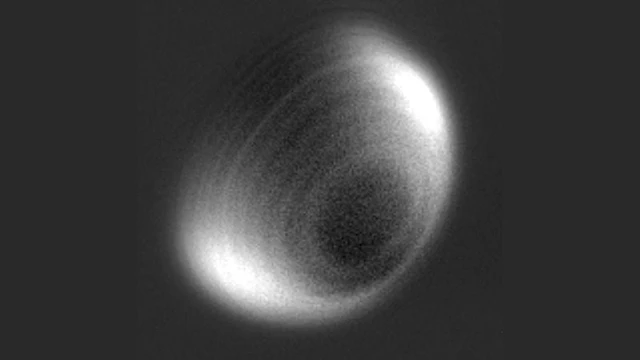
The genesis of this discovery traces back to a nearly serendipitous event: on May 24, 2010, during a brief 36-minute observation window, astronomers detected an anomalous signal. Giant concentric rings had emerged in the upper atmosphere of Venus, spanning a significant portion of the planet's illuminated hemisphere. Most striking was the fact that these structures remained entirely imperceptible in ordinary reflected light; they revealed themselves only through linear polarization, suggesting a specific physical nature of the objects or the medium through which the light traveled.
The technical architecture of the experiment relied on the capabilities of the ExPo polarimeter, mounted on the 4.2-meter William Herschel Telescope on La Palma. The instrument operated by splitting the light stream into two orthogonally polarized beams. To eliminate hardware distortions and neutralize the effects of Earth's atmospheric turbulence—the constant "shimmering" of the air—a liquid crystal modulator was employed to swap the beams at a frequency of 35 Hz. It was the application of narrow-band filters that ultimately allowed these rings, which had previously escaped the notice of the global scientific community, to be identified.
However, sixteen years elapsed between the initial data capture and its eventual publication. The reason for this protracted silence was both mundane and, for the researchers, professionally agonizing: by the time the data analysis was underway, the ExPo instrument had already been decommissioned, making it impossible to replicate the experiment. In science, data that cannot be reproduced or explained via existing physical frameworks are often dismissed as artifacts or measurement errors. Unable to provide a convincing explanation for the nature of the rings, the researchers deferred publication until external confirmation became available.
The turning point came with the analysis of data from the Japanese Akatsuki probe. The satellite detected a large-scale wave propagating from pole to pole within the Venusian atmosphere. This provided indirect evidence that planetary-scale atmospheric disturbances could indeed occur on the planet. Subsequent modeling demonstrated that such waves are capable of inducing local density increases of 5–10%, effectively transforming them into an efficient mechanism for transporting solar energy.
From the perspective of physical processes, these phenomena likely arise from the intense solar heating of the cloud layer, after which perturbations propagate across the planet driven by powerful winds. This is particularly relevant for Venus, where the phenomenon of "super-rotation" occurs: the cloud cover encircles the planet in just four Earth days—a speed that vastly exceeds the rotation of the planetary core around its own axis.
Today, these findings are presented to the scientific community not as an absolute truth, but as an invitation to discourse. The researchers are calling upon independent teams to verify the results and are hopeful for the advent of next-generation polarimeters. Such tools would allow us to peer through Venus's dense veil and determine whether these rings are the key to unlocking the mysteries of global atmospheric circulation on this scorching planet.
 The Hidden Dynamics of Mercury's Contraction


