The quest to uncover the energy limits of the universe has long been a cornerstone of modern astrophysics. While humanity constructs monolithic facilities to probe the mysteries of the microcosmos, the cosmos continues to unveil processes on a scale that utterly dwarfs our terrestrial capabilities. The discovery of an ultra-powerful radiation source within the Milky Way is fundamentally reshaping our understanding of natural particle accelerators. Cygnus X-3 has emerged as a new benchmark for extreme energy, operating at scales that far surpass the greatest achievements of human engineering.
Deep within our galaxy, an object has been discovered that effectively serves as a colossal physical experimenter. The LHAASO observatory in China has detected a source capable of accelerating protons to energies on the order of 30 PeV (petaelectronvolts). This is Cygnus X-3, located approximately 30,000 light-years from Earth. It stands as the most energetic known source of variable gamma radiation; recorded gamma photons reach energies of 3.7 PeV, elevating the study of this region into the realm of fundamental research in extreme physics.
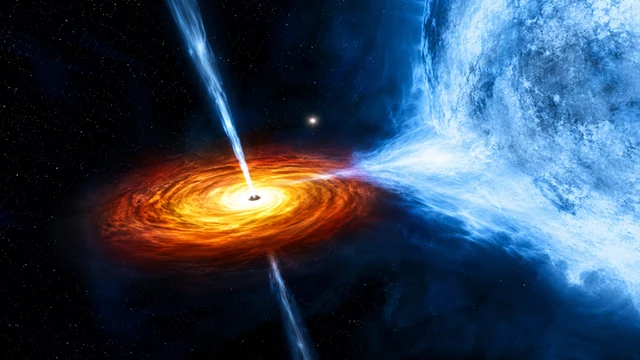
The mechanism driving this natural accelerator is rooted in the interaction between two bodies within a tight binary system. At the heart of the process lies a massive Wolf-Rayet star orbiting a compact object—most likely either a black hole or a neutron star. This compact object literally "devours" matter from its stellar companion. While some of this material is absorbed, a significant portion is ejected into space as narrow relativistic jets. It is at the base of these jets that protons receive a colossal impulse, reaching energies in the tens of petaelectronvolts.
The technical execution of this discovery was made possible by the LHAASO installation, situated at an altitude of 4.4 km in Sichuan Province. A pivotal element of the system is the KM2A sensor array, covering roughly 1.3 km², which records cascades of secondary particles. These particles are generated when high-energy gamma photons pierce Earth's atmosphere, leaving a cosmic "footprint." Data analysis reveals that the radiation intensity of Cygnus X-3 is unstable: energy bursts synchronize with lower-range signals previously captured by NASA’s Fermi telescope.
Of particular significance is the discovered signal periodicity of 4.8 hours. This time interval corresponds precisely to one full orbital revolution of the system's components. Such synchronicity allowed scientists to definitively link the radiation source to the binary system itself, ruling out the possibility that the signal originates from surrounding gas clouds. From a physical standpoint, accelerated protons collide with ultraviolet photons from the massive star, spawning unstable particles. Their subsequent decay generates a flux of gamma rays and neutrinos, transforming Cygnus X-3 into an ideal natural laboratory for studying matter accretion around black holes.
When comparing the power of this cosmic mechanism to terrestrial technology, it becomes evident that Cygnus X-3 outperforms the Large Hadron Collider (LHC) at CERN by approximately 4,400 times. This scale vividly validates Yakov Zeldovich’s assertion that the universe is an "accelerator for the poor." There is a profound irony in this expression: when humanity hits a financial and engineering ceiling in building ground-based installations, the only way forward is to look toward the cosmos, which provides tools beyond any earthly price tag.
 The 5,000-Day Milestone of Martian Exploration