Reentry into the dense layers of the atmosphere has historically been one of the most perilous phases of any mission, driven by the onslaught of extreme thermal loads. Conventional thermal protection systems rely on heavy ceramic tiling or ablative materials—substances designed to erode and burn away to shield the spacecraft's structural integrity. Today, however, a paradigm shift is underway: moving away from passive resistance toward the active manipulation of flow physics. Cutting-edge experiments in magnetohydrodynamic (MHD) braking are paving the way for the creation of "force fields" that could fundamentally streamline and secure the descent of spacecraft.
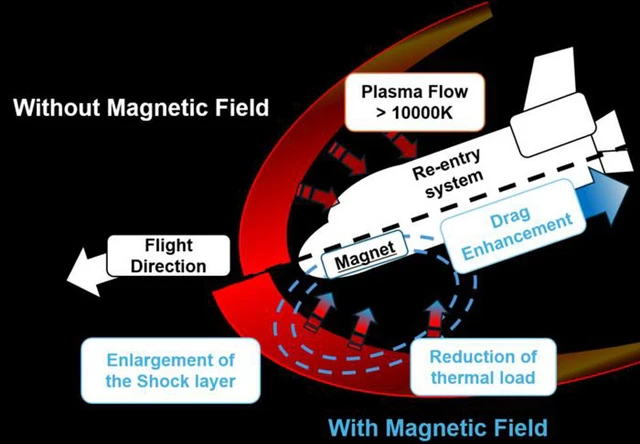
During hypersonic atmospheric reentry, a powerful shock wave forms ahead of the spacecraft. The air within this layer is compressed and heated to several thousand degrees, transforming into a partially ionized gas—plasma. This incandescent cocoon imposes a colossal thermal load on the hull, necessitating the use of heavy and costly thermal protection systems.
The concept of magnetohydrodynamic (MHD) braking leverages magnetic fields to interact with this plasma flow. From a physics perspective, the magnetic field acts upon the moving charged particles of the plasma, generating a Lorentz force that effectively repels the hot shock layer from the vehicle's surface. This not only increases the distance between the hull and the epicenter of the heat but also creates additional aerodynamic drag, effectively slowing the craft without the need for supplementary parachutes or braking thrusters.
For years, such research was limited to the use of permanent neodymium magnets within miniature models. However, this architecture suffered from a critical flaw: the static nature of the magnetic field precluded rapid adjustments to its configuration or intensity, significantly narrowing the range of testable parameters. A breakthrough occurred when a research team from Tokyo Metropolitan University replaced permanent magnets with a pulsed electromagnet comprising precision-engineered coils.
To power the system, a specialized pulsed circuit was developed, capable of delivering immense current within an extremely narrow window. This enabled the synchronization of the magnet's activation with the exact moment the shock wave passed through a hypersonic wind tunnel. In the experimental setup, the airflow reached speeds exceeding 7 km/s, closely mimicking actual orbital reentry conditions. Although the interaction lasted only tens of microseconds, this window was sufficient to record fundamental physical laws.
The trials utilized models with varying geometries and coil configurations, generating magnetic field strengths ranging from 1.24 to 1.58 Tesla. The latter figure is more than double the capacity of standard neodymium magnets, opening new horizons for analyzing field-plasma interaction. Using high-speed imaging, scientists captured the glow of the incandescent shock layer: upon activation of the magnetic field, the thickness of this layer increased by more than 15%. This provided direct experimental evidence that the plasma is indeed pushed away from the vehicle's surface.
The practical implications for modern astronautics are profound. Implementing MHD braking achieves a dual objective: reducing the heat flux on the hull while simultaneously increasing atmospheric drag. Consequently, the vehicle's kinetic energy is dissipated into the surrounding atmosphere rather than the spacecraft itself.
In the long term, this could lead to the abandonment of heavy, single-use ablative shields in favor of lightweight, reusable active protection systems. While current successes are limited to laboratory models, the development of a high-power controllable electromagnet is a critical step toward full-scale testing. The transition from theory to actual spacecraft will enable the creation of an entirely new class of reentry vehicles, where safety is ensured not by the thickness of ceramic plating, but by the precision of magnetic field control.
 Navigating via Earth's Gravitational Anomalies