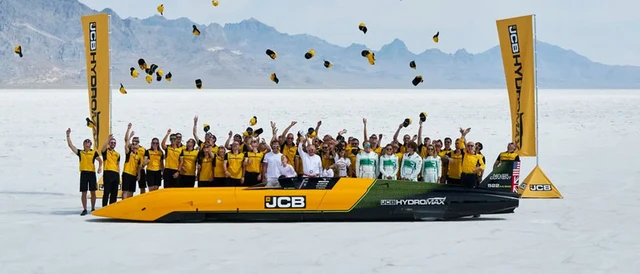
The pursuit of absolute speed has always been an intersection of engineering brilliance and raw human courage. Recent events at the Bonneville Salt Flats have signaled a new chapter in the evolution of propulsion systems—one where sustainability is no longer viewed as a compromise. The JCB Hydromax did not merely shatter world records; it validated the viability of hydrogen combustion under the most extreme operating conditions. This run stands as a powerful manifesto for the industry’s transition toward clean energy, proving that peak performance need not be sacrificed for environmental responsibility.
On August 11, 2026, the Bonneville Salt Flats in Utah became the stage for a historic milestone that redefined the boundaries of land speed. British pilot Andy Green—no stranger to extreme G-forces—pushed the JCB Hydromax to an average speed of 653.909 km/h. This achievement is more than just a statistic; it represents a quantum leap in alternative propulsion technology.
The record attempt was conducted under the stringent oversight of the Fédération Internationale de l'Automobile (FIA). Per regulations, the final figure is calculated as the average of two one-mile runs in opposite directions. In the first pass, the Hydromax clocked 400.623 mph (644.74 km/h), followed by a second run of 412.135 mph (663.27 km/h). A strict one-hour window and exhaustive technical inspections ensured the integrity of the experiment. Currently, the result remains provisional, pending final ratification by the FIA commission.
From an engineering perspective, the Hydromax is a marvel. The nearly ten-meter-long vehicle is powered by twin internal combustion engines fueled by compressed gaseous hydrogen. It is critical to distinguish this from electrochemical fuel cell processes; here, we see traditional combustion within cylinders, albeit with a radically different chemical composition. The powertrain evolved from production hydrogen engines used in JCB’s heavy machinery, which were heavily modified to withstand extreme performance demands. The combined output reached 1,600 hp—800 hp per unit.
The primary advantage of this configuration is its ecological footprint: the exhaust consists solely of pure oxygen and water vapor. This renders the vehicle effectively carbon-neutral while maintaining the raw dynamics of a hypercar.
A comparative analysis underscores the magnitude of this feat. The previous record for hydrogen ICE vehicles, set by the BMW H2R back in 2004, stood at a modest 298.5 km/h (185.5 mph). In essence, the Hydromax has doubled the efficiency benchmark for this technology. Furthermore, it eclipsed the company's own legacy—surpassing the 2006 record set by the diesel-powered JCB Dieselmax (563.4 km/h).
Ultimately, the Hydromax has emerged as the fastest hydrogen-powered land vehicle in history, regardless of fuel delivery method. By outperforming even the record-breaking fuel cell vehicles (303 mph), it proves that direct hydrogen combustion can deliver levels of power and velocity previously thought unattainable.
 Driver Attention Monitoring in Tesla Electric Vehicles