Space debris is evolving beyond a mere safety hazard, emerging instead as an unexpected instrument for fundamental science. The collision of a spent rocket stage with the lunar surface has effectively transformed a random incident into a unique physical experiment. Leveraging precise monitoring from South Korea’s Danuri spacecraft, researchers have gained a rare opportunity to benchmark theoretical impact models against empirical data. This event opens a new chapter in the study of cratering dynamics and the behavior of regolith under high-energy impacts.
The event captured by the Danuri orbiter stands as one of the most striking examples of man-made objects interacting with celestial bodies. On August 5, 2026, a derelict and fuel-depleted second stage of a Falcon 9 rocket collided with the lunar surface in the region of the Einstein and Bell craters. This massive object, weighing approximately four tons, struck the surface at roughly 2.43 km/s, releasing a staggering amount of kinetic energy—approximately 11.5 billion joules. To put this into perspective, the scale of the impact was comparable to the detonation of nearly three tons of TNT.
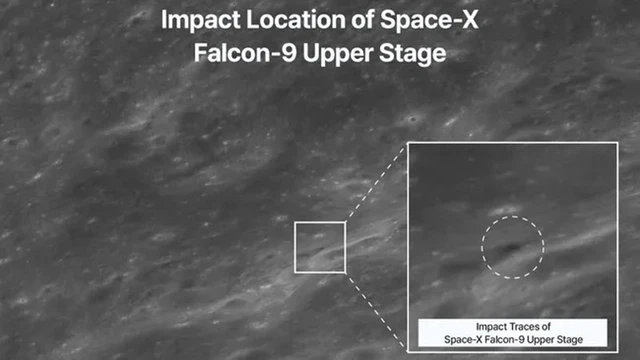
For researchers, the primary point of interest lies in the discrepancy between theoretical projections and the actual outcome. Prior to the collision, NASA estimated a crater diameter of approximately 18 meters with a depth of 3.7 meters. However, preliminary analysis of Danuri’s imagery suggests more substantial consequences: the crater's length may reach 27 meters. Final verification of these dimensions is pending the cross-referencing of data with imagery from the American Lunar Reconnaissance Orbiter (LRO), which will allow scientists to refine models governing the interaction of solid bodies at hypersonic velocities.
The trajectory toward this collision began in January 2025, when a Falcon 9 launched the private lunar missions Blue Ghost and Resilience into orbit. After completing its primary objective, the second stage remained in a high elliptical Earth orbit. Lacking the means for deceleration or controlled deorbiting, the object became subject to gravitational perturbations. Over the course of eighteen months, the combined influence of the Sun and Moon, compounded by solar activity, gradually shifted the stage's trajectory until it was ultimately captured by lunar gravity.
From a scientific standpoint, Danuri provided an invaluable dataset through a series of eight imaging sessions conducted immediately before and after the impact. In astrophysics, it is exceedingly rare to obtain "before and after" imagery of the same surface area with such temporal precision. This allows researchers to eliminate variables such as lighting or camera angles, focusing exclusively on crater geometry and the analysis of ejected regolith distribution.
While meteoroids of comparable energy bombard the Moon approximately every six days, they remain "anonymous" entities with unknown masses and impact vectors. The Falcon 9 incident is unique because the object's parameters were known in advance, effectively transforming a catastrophic collision into a controlled experiment to validate models of dust plume propagation and the detection of artificial bodies in cislunar space.
Confirmation of the impact came not only from orbit but also from Earth. Using a spectrometer on the Very Large Telescope (VLT) in Chile, European astronomers detected signatures of lithium and sodium within the dust cloud hovering over the impact site. While sodium is a natural component of lunar soil, lithium is found exclusively in the rocket's structural materials; thus, this chemical marker served as irrefutable evidence of the event's anthropogenic origin. Simultaneously, specialists from the Institute of Astrophysics of Andalusia in Spain report the possible capture of the exact moment of ejecta release, which is currently undergoing expert verification.
 Next-Generation Ultra-Lightweight Lens Technology