The transition toward renewable energy is driving offshore wind farms further from the coastline, where wind patterns are more consistent and potent. However, transporting electricity across vast oceanic distances presents a fundamental engineering hurdle: significant power loss inherent in alternating current (AC) transmission. China has addressed this challenge by developing an offshore direct current (DC) converter of unprecedented scale—a project that marks a new milestone in the evolution of global energy infrastructure and industrial engineering.
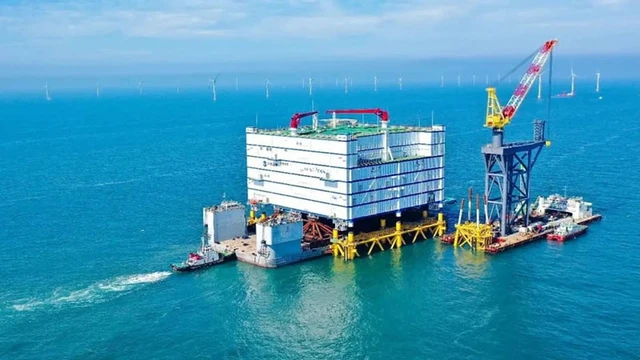
In the South China Sea, approximately 100 kilometers off the coast of Yangjiang, lies an installation already dubbed the “Heart of the Sea Wind”—Hai Feng Zhi Xin. More than just a technical platform, it is the world’s largest offshore High-Voltage Direct Current (HVDC) converter station. The scale of the structure is staggering: a 25,000-ton steel superstructure comparable in height to a seven-story building, with a footprint exceeding 7,000 square meters.
The technical necessity for such a behemoth is dictated by the laws of physics. Traditional Alternating Current (AC) systems face a critical hurdle when deploying long undersea cables: high capacitive loading. This leads to significant energy dissipation and severely limits the line's throughput. HVDC technology solves this challenge by converting AC from wind turbines into direct current, enabling the transmission of massive volumes of energy over hundreds of kilometers with minimal loss. Operating at 500 kV with a capacity of 2 GW, Hai Feng Zhi Xin serves as the central hub for the Qingzhou V and VII wind farms.
The installation process was an engineering feat in its own right. Given that vessels capable of transporting and mounting a structure of this mass in open waters are virtually non-existent, engineers employed a strategy of modular assembly combined with a float-over installation method. The entire superstructure was fully outfitted on shore before being transported as a single unit via a semi-submersible vessel.
The precision required to mate the platform with its foundation is particularly noteworthy. The 17,000-ton base, anchored to the seabed by concrete piles, had to receive the superstructure with surgical accuracy. Despite the volatility and dynamics of the open sea, engineers managed to maintain a gap of just 15 centimeters between the structure and its support. This was made possible through continuous monitoring of tides and swells, coupled with precise control of ballast tanks and the vessel's dynamic positioning systems.
To ensure long-term durability, every component—from ventilation to fire suppression—was hardened against the aggressive saline environment and extreme humidity. The station is fully remotely managed, minimizing the need for permanent personnel presence in the open ocean.
The economic and environmental dividends of this 300 km energy corridor will be felt across the entire region. The system will supply power to cities across Guangdong province, Hong Kong, and Macau, delivering approximately 6 TWh of renewable energy annually. In terms of traditional resources, this equates to saving roughly 1.74 million tons of standard coal and reducing carbon dioxide emissions by 4.63 million tons per year.
Beyond the ecological impact, the advancement of HVDC technology holds strategic importance for the future of the digital economy. Direct current transmission is increasingly viewed as the most efficient method for powering hyperscale data centers and AI infrastructure, which demand immense energy density. The expertise gained from the "Heart of the Sea Wind" could provide the blueprint for new power supply standards for global computing clusters.
 The Hidden Dynamics of Mercury's Contraction


