For decades, the concept of invisibility remained the exclusive province of science fiction and theoretical speculation. Today, however, the boundary between fantasy and physics is dissolving, driven by the meteoric rise of nanophotonics. Researchers at the University of California, Los Angeles (UCLA) have unveiled a system that fundamentally upends our traditional perception of reflection. This "lying mirror" does more than simply bounce light back; it effectively rewrites the signal, operating entirely passively—without a single electron or external power source.
At the heart of this technological breakthrough is the development of what researchers call a "lying mirror"—a passive optical system capable of transforming incident light into a predetermined image. Unlike a conventional mirror, which operates on the principle of simple reflection, this device functions as a physical converter. Rather than merely duplicating reality, it constructs a new visual entity by leveraging the laws of wave optics.
The technical implementation of the system relies on a structured diffraction surface. At the microscopic level, this surface consists of elements designed to precisely manipulate the phase of reflected light. To achieve flawless transformation accuracy, the researchers employed deep learning methods; neural network algorithms calculated the surface geometry so that any incoming light flux, upon interacting with the mirror, would coalesce into a specific, predefined pattern.
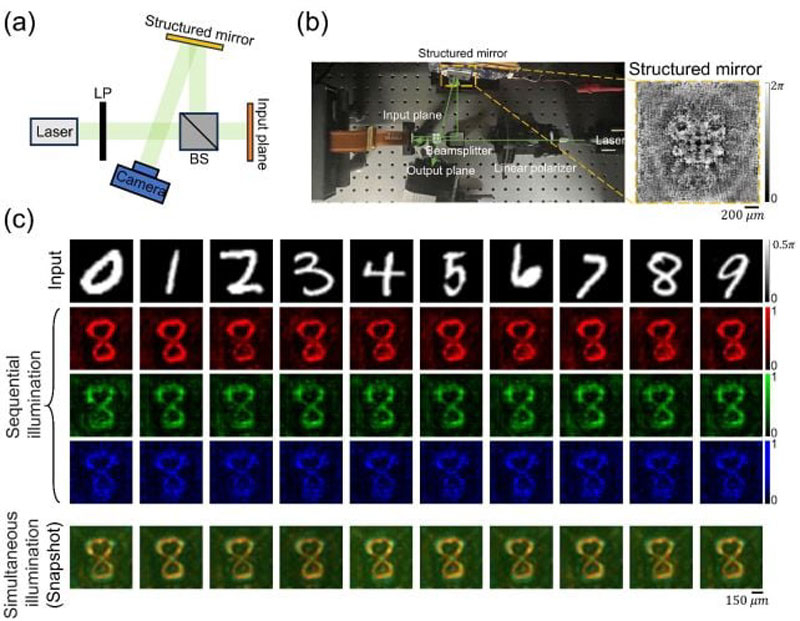
In essence, the device operates on principles akin to holography, but with one critical distinction: it does not require a powerful point source of light to reconstruct the image. Instead, the process occurs through the interference of multiple incident rays, including those reflecting off the observer themselves. This effectively turns the mirror into a type of analog computer where computations happen at the physical level of light, entirely eliminating the need for displays, batteries, or integrated circuits.
During experimental trials, prototypes demonstrated efficiency at wavelengths of 480, 550, and 600 nm, corresponding to the primary RGB (red, green, blue) channels. The researchers successfully achieved transformations for both individual colors and their mixtures. Furthermore, a broadband version was developed, capable of operating across a continuous spectrum of wavelengths. Practical tests yielded impressive results: the system could transform an image of clothing into a handbag, random digits into the number eight, and simple sketches into a detailed depiction of a panda's face.
However, transitioning from a laboratory bench to a commercial product presents significant challenges. Current successes were achieved under strictly controlled conditions using coherent lighting and fixed beam directions. In the real world, we deal with incoherent light (such as sunlight or ambient indoor lighting) hitting the surface at random angles, which degrades the clarity of the diffraction pattern. Overcoming this barrier will require a shift toward more complex, multi-layered volumetric structures capable of manipulating light in three-dimensional space.
The potential applications of this technology extend far beyond simple visual illusions. The most ambitious frontier is the creation of optical cloaking systems. Rather than attempting to make an object entirely transparent, the surface could replace its image with something visually neutral or blend it seamlessly into the background. Beyond camouflage, the potential for "lying mirrors" extends into cybersecurity, the development of protective screens, and entirely new formats of interactive entertainment.

 Anthropic’s Strategic Push for Hardware Independence