The Sun serves as a colossal natural reactor, where physical processes unfold on an extreme scale. Cutting-edge observational techniques are now allowing us, for the first time, to peer into the architecture of this turbulence with unprecedented clarity. Fresh data from the world's most powerful solar telescope reveals intricate plasma dynamics that evoke the fluid beauty of an Impressionist masterpiece. These visual revelations are proving pivotal to decoding the mechanisms governing space weather—forces that directly impact the technological fabric of our planet.
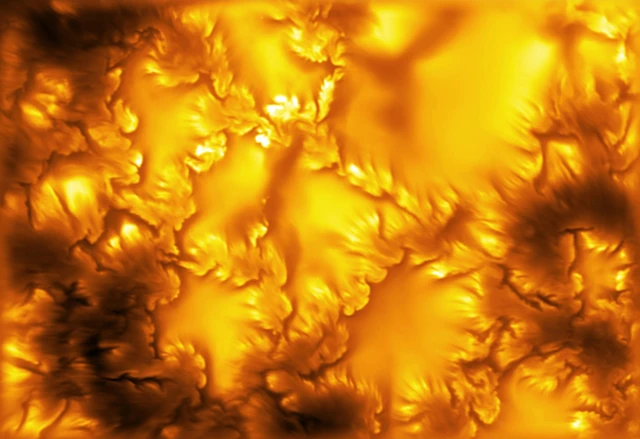
Contemporary astrophysics has entered a new era of precision with the deployment of the Daniel K. Inouye Solar Telescope (DKIST) in Hawaii. As the most powerful ground-based instrument ever dedicated to solar study, DKIST has enabled researchers to capture the star's outer atmosphere with a resolution previously deemed unattainable. The findings, published in Nature, reveal not merely a static surface, but a living, pulsating environment whose visual patterns evoke the swirling aesthetics of Van Gogh’s "The Starry Night."
Beneath the artistic allure of these "brushstrokes" lies a fundamental physical process. Astronomers have identified specific instability waves on the solar surface, triggered by the interaction of magnetized plasma flows. When two layers of plasma move relative to one another at differing velocities, characteristic vortices form at their boundary. In classical fluid dynamics, this phenomenon is known as the Kelvin-Helmholtz instability—the same mechanism that shapes wind-driven ripples on water or the atmospheric cloud structures seen on Earth and gas giants like Jupiter and Saturn.
However, the scale and clarity with which this phenomenon manifested on the Sun have sent shockwaves through the scientific community. While such processes were previously recorded only indirectly or in low resolution, DKIST has allowed them to be observed in real-time dynamics, effectively transforming theoretical models of magnetohydrodynamics into a vivid visual reality.
The practical implications of these discoveries extend far beyond academic curiosity. Understanding the internal structure and turbulence of the solar corona is critical for predicting space weather. It is within these zones of instability that powerful Coronal Mass Ejections (CMEs)—colossal plumes of plasma hurtling into deep space—are born.
When these ejections reach Earth, they trigger geomagnetic storms. The repercussions are felt across every facet of our modern technological society: from GPS signal degradation and radio communication failures to the total disruption of satellite systems. Simultaneously, these same processes orchestrate the mesmerizing auroras, turning solar activity into a grand celestial light show at our planet's poles. Consequently, the detailed study of the Sun’s "plasma canvases" has become a matter of global technological security.
 Next-Generation Ultra-Lightweight Lens Technology