For decades, the global DRAM market has remained a fortress guarded by a triumvirate of tech giants. Today, however, this oligopoly faces a formidable challenge from the Chinese contender, CXMT. Despite stringent restrictions on access to cutting-edge fabrication equipment, the company is demonstrating aggressive growth and rapidly eroding the incumbents' market share. This shift may well be the harbinger of a systemic restructuring of the entire semiconductor industry.
For years, the DRAM (Dynamic Random Access Memory) segment has been regarded as one of the most conservative and impenetrable niches in electronics. The barriers to entry are formidable, driven not only by massive capital expenditures but also by the requirement for mastery over the most complex lithography processes. However, recent data from Counterpoint Research indicates that the Chinese firm CXMT is successfully dismantling these barriers. By mid-2026, its revenue share reached 10%, the result of an impressive surge: annual revenue grew by 150%, with quarterly dynamics adding another 25%.
This success is particularly significant given the prevailing geopolitical headwinds and China's restricted access to cutting-edge EUV (Extreme Ultraviolet) lithography equipment, which is critical for producing chips using the most advanced process nodes. CXMT's ability to expand its footprint using available tooling speaks to highly efficient production optimization and substantial state backing.
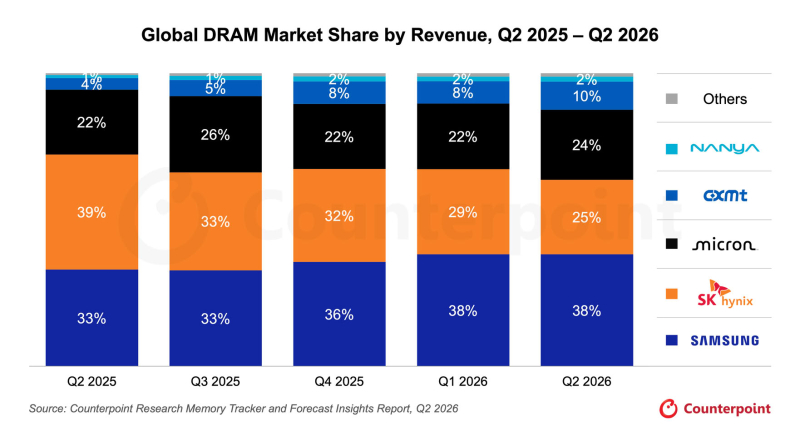
Meanwhile, the traditional "Big Three" are experiencing a period of internal volatility. Samsung continues to hold the lead with a 38% share, further consolidating its position. The situation for other players is more nuanced: SK hynix, which previously dominated certain segments, has seen its presence contract from 39% to 25%. Micron remains relatively stable, fluctuating between 22% and 24%, while the smaller player, Nanya, managed to double its share, rising to 2%.
However, the true strategic battleground is the HBM (High Bandwidth Memory) segment—memory with high throughput that has become a critical component for modern AI accelerators. Here, the rules of engagement are different, and the market remains virtually impenetrable for new entrants.
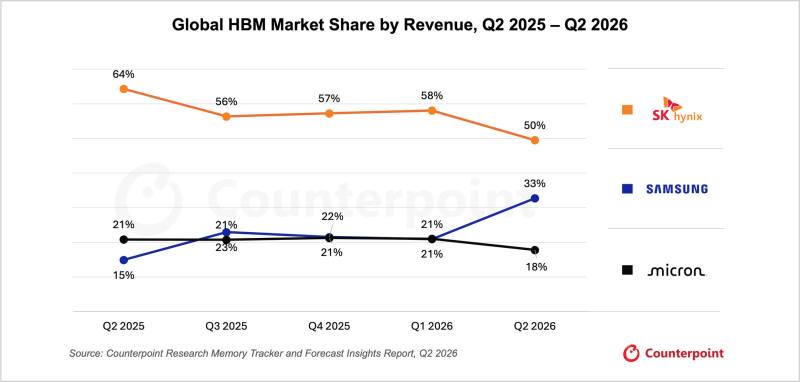
In the realm of HBM, SK hynix remains the dominant force with 50% of the market, although it has seen a notable decline compared to last year, when it controlled 64% of revenue. The primary beneficiary of this redistribution has been Samsung, which now holds 33%. The Korean giant is aggressively scaling its shipments, leveraging the industry's transition from the HBM3E standard to the next generation—HBM4—allowing it to reclaim lost ground. Micron rounds out the trio with an 18% share.
As for CXMT, the company has yet to make a mark in HBM statistics. The Chinese manufacturer has only just begun producing HBM3E-standard memory, and its impact on overall market revenue is not yet visible. Nevertheless, analysts expect CXMT to begin competing in earnest within this high-tech segment over the next one or two quarters, which could exert additional pressure on Korean and American manufacturers.
Consequently, we are witnessing the emergence of a new paradigm: China is ceasing to be a mere consumer of memory and is transforming into a serious supplier, capable of influencing global pricing and market shares even under the constraints of a technological blockade.
 Nvidia N1X and the New Era of Arm PCs