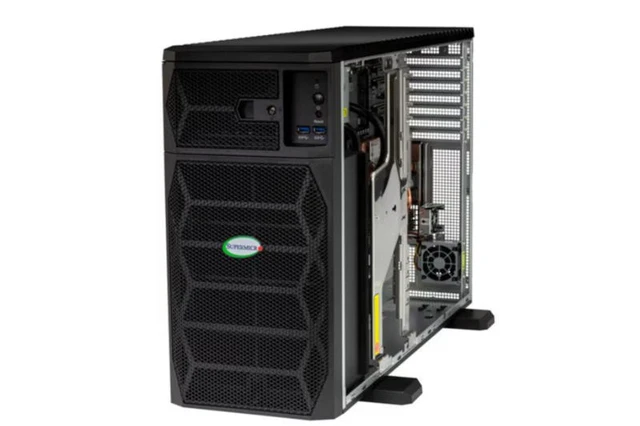
The era of cloud dependency is gradually giving way to a pursuit of local data sovereignty. Today’s research institutions and enterprises demand the capacity to deploy trillion-parameter models without the latency or security vulnerabilities associated with data leaks. Supermicro’s latest workstation, powered by the Nvidia GB300 Grace Blackwell Ultra chip, stands as the physical manifestation of this shift. It is no longer merely a computer; it is, effectively, a data center condensed into a desktop form factor, engineered specifically for the age of generative AI.
The professional computing landscape is undergoing a fundamental shift: the line between the server rack and the desktop has all but vanished. The debut of the Supermicro ARS-511GD-NB-LCC-01-G2 workstation serves as a vivid illustration of this convergence. With a price tag reaching $93,000, the device transcends the traditional concept of a "personal computer." For perspective, even Apple's top-tier solutions, such as the Mac Studio powered by the M5 Ultra chip, cost nearly seven times less—though they operate in an entirely different class of workloads.
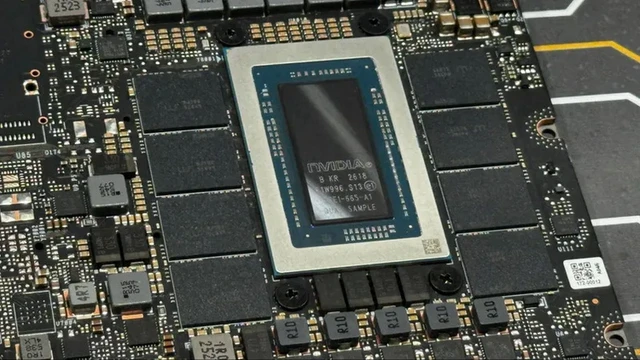
The system's architecture is built upon the synergy of two Nvidia powerhouses: the Grace CPU and the Blackwell Ultra GPU. This pairing enables a colossal memory capacity of 748 GB. Resource allocation is meticulously optimized for heavy neural networks: 496 GB is dedicated to the system tasks of the 72-core Grace processor, while 252 GB of high-speed HBM3e memory is allocated to the graphics subsystem. Such a configuration allows for the local deployment of massive Large Language Models (LLMs) with trillions of parameters—capabilities previously reserved for full-scale server clusters.
Performance in FP4 precision reaches an impressive 20 PFLOPS, making it three times faster than its predecessor, the H200 accelerator. In real-world scenarios, this translates into blistering text generation speeds, with AI agents capable of outputting up to 1,200 tokens per second. This transforms the station into the ideal instrument for continuous inference and real-time model fine-tuning.
The station's technical foundation is engineered to withstand extreme workloads. Data storage is handled by four M.2 NVMe drives (two 1.92 TB and two 960 GB units), with the system already future-proofed via support for PCIe 5.0 and 6.0 standards. Networking capabilities are headlined by two 400-Gigabit Ethernet ports powered by the Nvidia ConnectX-8 SuperNIC, ensuring minimal latency for intra-network data transfer. For administrators, a dedicated LAN port with IPMI support allows for remote diagnostics and system health monitoring.
Sustaining this level of computational throughput requires a rigorous approach to power delivery and thermal management. A 1600W Titanium-certified power supply (94% efficiency) guarantees stability even under peak loads. To tame the heat generated by the Grace and Blackwell chips, Supermicro has implemented a hybrid cooling solution: a high-performance fan array supplemented by liquid cooling. Weighing approximately 40 kg, the device's mass underscores its industrial nature.
This workstation is not intended for the general consumer, but for a select group of specialists—researchers and corporate architects for whom autonomy and maximum compute density per square meter of workspace are mission-critical.
 Nvidia N1X and the New Era of Arm PCs