The global semiconductor landscape is undergoing a fundamental transformation. China is rapidly closing the technological gap with South Korean titans, effectively condensing years of deficit into a brief interval. The primary battleground has shifted to High Bandwidth Memory (HBM), the indispensable backbone of contemporary artificial intelligence. Despite stringent equipment restrictions, Beijing is doubling down on innovative advanced packaging techniques and leveraging massive state support.
For years, South Korean industry leaders viewed the technological divide between themselves and their Chinese counterparts as a five-year chasm. Today, however, that distance is closing with startling speed. In the most critical and complex arena—High Bandwidth Memory (HBM)—the lead has narrowed to three years; in other segments, the disparity has dwindled to a mere one or two.
CXMT has emerged as a focal point of industry scrutiny. Reports indicate the company has already entered the testing phase for the fifth generation of memory, known as HBM3E, with mass production slated for next year. To put this in perspective, HBM3E is only one generation behind HBM4—the current gold standard already in serial production by Samsung, SK hynix, and Micron Technology. Concurrently, industry insiders suggest that CXMT has already achieved mass production of HBM3.
This breakneck pace of progress is fueled by a potent combination of China's colossal domestic market, a sophisticated R&D ecosystem, and direct state patronage. Chinese engineers are demonstrating a phenomenal capacity for adaptation; milestones that took Western and Korean competitors three years to achieve are being cleared in China in just one.
The primary bottleneck remains the lack of access to cutting-edge Extreme Ultraviolet (EUV) lithography scanners, which are essential for fabricating chips with ultra-fine process nodes. In response, Chinese firms have pivoted their strategy, shifting focus from the lithography process itself toward advanced packaging and the integration of heterogeneous components.
One of the most promising breakthroughs is X-Stacking, a technology YMTC employs in its 3D NAND production. By effectively "fusing" two silicon wafers, this method drastically shortens the electrical signal path, resulting in significantly higher throughput and reduced power consumption—all without the need for prohibitively expensive EUV equipment. Huawei has pursued a similar trajectory with its "chip folding" concept, where two halves are linked via vertical interconnects.
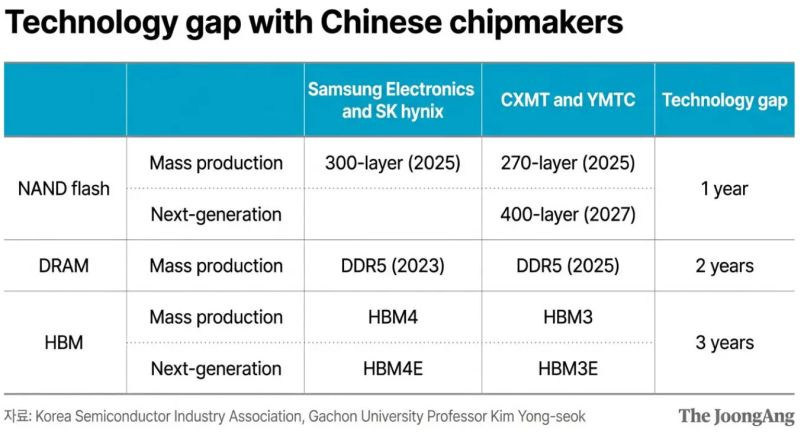
China's expansion extends beyond HBM. In the DDR5 segment, the gap with Korean leaders has narrowed to two years. Even more striking are the results from YMTC in 3D NAND production: last year, the company reached 270 layers, trailing the Korean benchmark of 300 by a slim margin. It is expected that China could seize the initiative as early as next year with the introduction of 400-layer memory.
Economic metrics underscore the scale of this surge. CXMT has already climbed to fourth place globally in DRAM revenue with a 10% market share, while posting a staggering operating margin of 82%—outperforming both of its South Korean rivals. YMTC, meanwhile, controls 14% of the global NAND market and is angling for global leadership by the end of next year. Financial backing remains robust; CXMT's public listing has unlocked nearly $10 billion to expand its manufacturing capacity.
However, this technological optimism is colliding with the harsh realities of semiconductor fabrication. The critical pain point remains the low yield rate. For HBM3E, CXMT’s yield reportedly does not exceed 25%, whereas the industry benchmark sits at 80%. Such a high failure rate inevitably drives up production costs and constrains actual shipping volumes, serving as a stark reminder that the path to absolute technological sovereignty is still fraught with formidable engineering hurdles.

 The Commercial Debut of the Googlebook Ecosystem