The visual display industry is steadily pivoting away from conventional standards, driven by a pursuit of total immersion and seamless multitasking. Ultra-wide displays are evolving beyond niche status, transforming into comprehensive workstations tailored for both power users and gaming enthusiasts. HKC is taking another ambitious leap in this direction with the introduction of a device featuring a non-conventional aspect ratio. The Tianqi 43H180C is engineered to redefine how users interact with their digital environment.
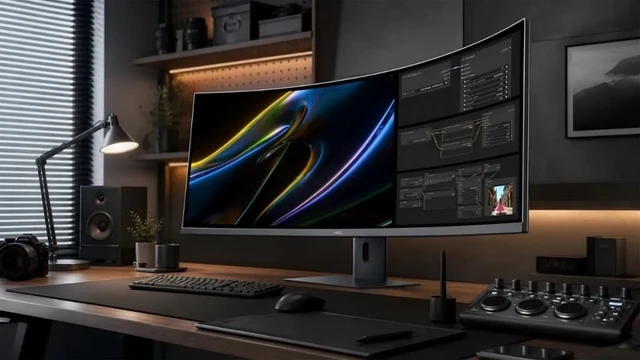
The contemporary monitor market has long since evolved past the traditional 16:9 aspect ratio, yet HKC has decided to push beyond even the widely accepted 21:9 standard. The new Tianqi 43H180C, boasting a 43.8-inch diagonal, introduces a radical 24:9 aspect ratio. In essence, this is an evolution of the 4K panel, stretched horizontally to achieve a resolution of 5760 × 2160 pixels. This approach creates a unique visual experience, blending high-end pixel density with a panoramic field of view.
This experimental approach to form factors is no accident. The company previously signaled its ambitions at Computex by unveiling the massive Shield C83U60, an 83.4-inch monitor with 12K resolution. It is evident that HKC is aiming for the ultra-premium display niche, where scale and resolution serve as tools to expand the user's cognitive bandwidth.
The technical specifications of the Tianqi 43H180C are impressive. At its core is a Mini-LED backlit panel, delivering deep blacks and high peak brightness through local dimming. The 1000R curvature is designed to closely mimic the natural human field of vision, reducing eye strain and heightening immersion. A 180Hz refresh rate, paired with 99% DCI-P3 color gamut coverage, ensures the monitor is suited not only for fast-paced gaming but also for professional color-critical work. While the specific panel type (VA or IPS) remains officially undisclosed, the overall spec sheet suggests a calculated balance between contrast and viewing angles.
The functional approach to workspace organization is particularly noteworthy. The monitor supports advanced screen-splitting modes, effectively transforming a single panel into a full multi-monitor setup. Users can divide the display into three equal zones of 1920 × 2160 pixels or dedicate the center to full 4K content, leaving the side panels for auxiliary tools such as chats, timelines, or documentation.
In terms of connectivity, the device is engineered for the most demanding modern hardware. The inclusion of DisplayPort 2.1 is critical, as a resolution of 5760 × 2160 contains approximately 50% more pixels than standard 4K. This places a significant load on the GPU, requiring maximum data bus bandwidth even from flagship cards. The feature set is rounded out by a USB-C port with 96W power delivery and an integrated KVM switch, allowing the user to control two separate computers with a single set of peripherals.
The Tianqi 43H180C represents an attempt to create a universal tool that blurs the line between a professional production monitor and an uncompromising gaming solution. Although pricing and availability remain unknown, the device clearly signals the industry's trajectory: the shift toward ultra-wide formats with high pixel density is becoming the new standard for those who find traditional screens too restrictive.
 Samsung M16: A New Standard for OLED Panels