The quest to identify satellites beyond our own Solar System has long stood as one of the most formidable challenges in modern astrophysics. While exoplanets have transitioned into routine subjects of study, detecting their moons demands an extraordinary level of instrumental precision and rigorous data synthesis. A recent discovery within the CD-35 2722 system is now challenging our conventional understanding of celestial hierarchies; the nature of this object suggests that the boundary between a planet and its moon may be far more porous than previously assumed.
The quest for exomoons transcends mere aesthetic curiosity about distant worlds; it is driven by a fundamental necessity to decode the evolution of stellar systems. Satellites play a pivotal role in planetary dynamics, influencing axial tilt, climate, and even the potential for habitability. For years, astronomers have operated primarily with hypothetical candidates, but recent data brings us closer to the official confirmation of the first alien moon.
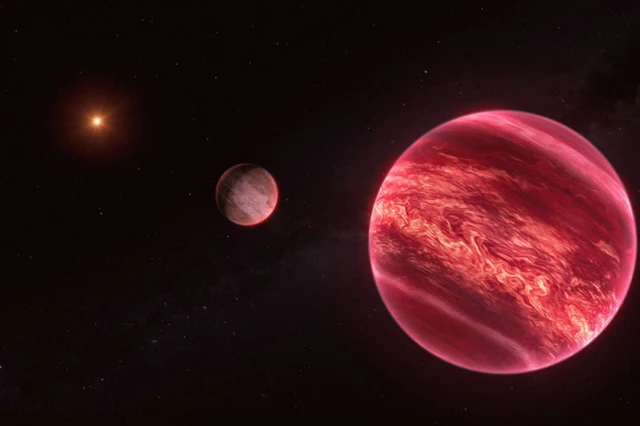
The current focal point is the young system CD-35 2722, located approximately 70 light-years from Earth. Its architecture is highly specific: a central red dwarf with roughly 40% of the Sun's mass is orbited by the brown dwarf CD-35 2722 B, which possesses about 37 Jupiter masses. Brown dwarfs are essentially "failed stars"—objects too massive to be classified as planets, yet insufficient in mass to sustain full thermonuclear hydrogen fusion. It is around this object, situated 67 astronomical units from the primary star, that a new companion has been detected.
From a technical standpoint, the object occupies the position of a satellite within the system's three-tier hierarchy; however, its mass is comparable to that of a full-fledged planet. Due to this duality, researchers employ the term "exomoon" to highlight the ambiguous nature of its classification.
The discovery was made using the radial velocity method. This technique involves detecting the gravitational tug of an invisible satellite on its parent body: the exomoon causes the brown dwarf to undergo slight oscillatory movements, which in turn triggers a periodic shift in the emission spectrum—the Doppler effect.
Observations were conducted between October 2023 and February 2026 using the CRIRES+ infrared spectrograph on the ESO's Very Large Telescope (VLT) in Chile. Exceptional data precision was achieved through the use of adaptive optics and a narrow instrument slit, which allowed researchers to almost entirely filter out light from the central star and focus exclusively on the spectrum of the brown dwarf.
Analysis of the measurements revealed radial velocity modulation with a period of approximately 170 days. Based on this data, the most physically grounded model suggests a single satellite orbiting the brown dwarf with a period of 171.1 days and a minimum mass of 0.92 Jupiter masses. An alternative scenario was considered: the presence of two satellites with masses of 0.87 and 0.22 Jupiter masses in a 2:1 orbital resonance. However, detailed dynamic stability calculations demonstrated that such a binary system would be ephemeral, collapsing in less than 500 years. Consequently, the single-massive-exomoon model remains the primary hypothesis.
Despite these promising results, the scientific community remains cautious and has stopped short of declaring the object the first officially confirmed exomoon. Further measurements are required for final orbital verification. Nevertheless, the mere detection of a Jupiter-sized object acting as a moon forces a reconsideration of the classical definitions of planets and satellites established within the framework of our own Solar System.
 China's Quest for Lithographic Independence