Monitoring polar regions and icebergs has long been hampered by treacherous terrain and inherent surface instability. Conventional UAVs are constrained by the necessity of locating level landing zones, rendering the granular analysis of ice masses an arduous undertaking. The solution lies in the development of a device leveraging biomimetic principles to ensure secure attachment to steep, precipitous slopes. This technological leap opens new frontiers for the long-term, autonomous surveillance of Earth's cryosphere.
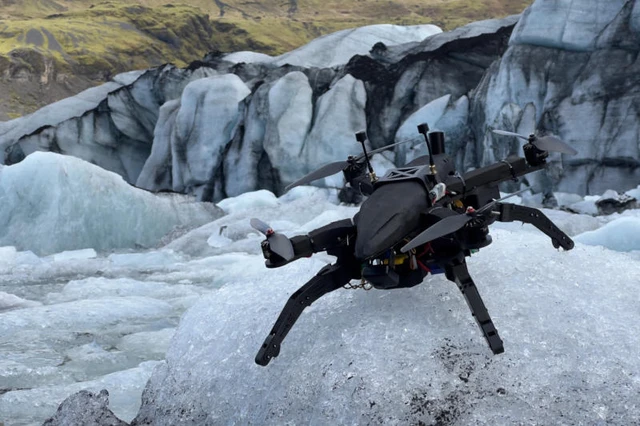
The autonomous deployment of sensors on icy surfaces has long been a persistent technical bottleneck for glaciologists. Conventional drones typically require a perfectly level landing surface or simply slide off glaciated slopes. To address this, engineers from the University of Sherbrooke have proposed a radical approach; drawing inspiration from the anatomy of feline paws, they developed "Ice Dart"—a device designed to literally anchor itself into the ice.
The efficacy of the fixation system is driven by the synergy of three distinct engineering innovations. The first line of defense consists of four carbon-fiber struts arranged in a cruciform pattern. With a total mass of 2.65 kg, the assembly's defining feature is its multi-directional, spring-loaded spikes. This configuration eliminates the need for surgical precision during the approach; upon contact, the spike best positioned for penetration engages the ice.
However, mechanical grip alone is insufficient, as the kinetic energy generated during landing can easily repel the device. To mitigate this, the team implemented a sophisticated damping system comprising 28 friction disks. These disks effectively absorb the impact load, neutralizing the "bounce" effect—a critical requirement, as only a stable, high-pressure contact allows the spikes to embed deeply into the ice structure.
The third and most technologically advanced element is dynamic thrust vectoring. At the moment of touchdown, the drone's rotors momentarily shift their operational direction, creating an impulse that drives the device firmly against the wall or slope. In scenarios involving extreme inclines where gravity no longer aids the landing, this artificial thrust ensures the "claws" achieve final fixation.
Field trials were conducted under the grueling conditions of Icelandic glaciers. Amid temperatures ranging from 0 to 10°C and wind gusts exceeding 30 km/h, Ice Dart demonstrated exceptional stability, successfully executing 24 landings on slopes with gradients up to 58°. Laboratory tests yielded even more impressive results, with the device managing angles of up to 60° at landing speeds of 3 m/s.
The implications of this technology extend far beyond initial testing. The ability to securely anchor on icebergs enables the deployment of long-term monitoring networks without requiring drones to remain airborne, significantly extending the operational lifespan of the sensors. While full-scale trials on open-ocean icebergs are yet to come, current results validate the viability of biomimetic gripping mechanisms in extreme environments.
 Endurance Limits of the Xiaomi Skynomad N90 Max