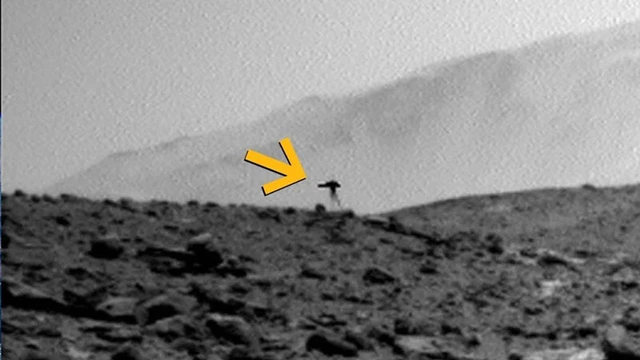
The quest for extraterrestrial intelligence frequently begins not with a groundbreaking discovery, but with a technical glitch. Recent viral images captured by the Curiosity rover have once again ignited fantasies of "combat tripods" and alien artifacts lurking within Gale Crater. Yet, behind this veil of mystery lies the stark physics of cosmic radiation and the intrinsic behavior of semiconductors. This instance serves as a vivid demonstration of how the absence of a planetary magnetic field effectively transforms camera sensors into cosmic ray detectors.
The contemporary digital age has conditioned us to trust the visual, yet in the stark environment of deep space, imagery can be deceptive. A recent photograph captured by the Curiosity rover became a focal point of speculation, depicting a strange object resembling a dark, tentacled dome. In the echo chamber of social media, this image was rapidly rebranded as a "Martian jellyfish" or even a fighting machine straight from the classic novels of H.G. Wells. However, the psychological phenomenon of pareidolia—the human brain's tendency to perceive familiar patterns in random structures—transformed a routine technical artifact into a global sensation.
To decipher the nature of this "extraterrestrial," one must examine the architecture of the imaging systems. Curiosity's navigation cameras utilize Charge-Coupled Devices (CCDs), which are exquisitely sensitive to high-energy particle interference. When a heavy ion or proton from deep space penetrates the sensor's silicon substrate, it triggers an instantaneous burst of electrons. The result is digital noise on the final frame: this can manifest as a single bright pixel, a streak, or, in more complex instances, a blurred smudge that mimics an organic form.
The planetary environment plays a pivotal role here. Unlike Earth, Mars lacks a global magnetic field to serve as a shield against solar wind and galactic cosmic radiation. Furthermore, the Red Planet's tenuous atmosphere—a mere 0.5% of Earth's—provides virtually no filtration for high-energy particle flux. Under these conditions, camera sensors effectively function as exposed targets for cosmic irradiation.
Such incidents are far from anomalous. NASA's imaging system specialists have repeatedly confirmed that "digital ghosts" haunt Curiosity's photographs almost weekly. While they most frequently appear as white flashes, dark artifacts also occur, particularly when utilizing specialized hardware like the Hazcams (Hazard Avoidance Cameras).
The decisive argument for a technical glitch lies in temporal analysis. The "jellyfish" image was captured at a specific moment; however, frames taken by the same camera just 13 and 25 seconds prior reveal an entirely pristine landscape. Had the object physically existed within Gale Crater, it would inevitably have appeared across a sequence of consecutive shots. The fact that the anomaly appeared on only one frame points unequivocally to an internal glitch within the imaging system.
Ultimately, the "Martian tripod" is not evidence of an alien civilization, but rather a practical lesson in astrophysics and electronic engineering. It serves as a stark reminder that in the scientific interpretation of data, rigorous verification and an understanding of the operational environment are critical. Without them, any random noise can be mistaken for a signal from the depths of space.
 Starship's Return from the Indian Ocean