Deep space exploration frequently yields its most surprising rewards when instruments venture beyond their primary mandates. The Euclid Observatory, originally engineered to unravel the enigmas of dark energy, has unexpectedly evolved into a formidable instrument for probing the depths of our own galaxy. Leveraging extreme instrument sensitivity, the mission has produced a map of the Milky Way's stellar core with unprecedented resolution. This technological leap does more than merely expand humanity's visual archive; it establishes the critical foundation for the discovery of thousands of new exoplanets.
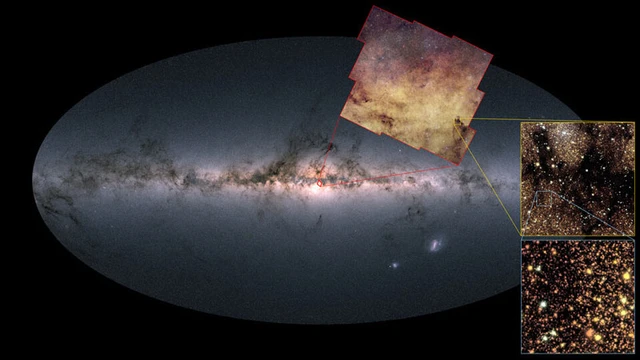
The Euclid space observatory was initially conceived as an instrument for analyzing the large-scale structure of the universe, designed to elucidate the nature of dark matter and dark energy. However, the telescope's expansive optical field of view and exceptional resolving power have enabled astronomers to repurpose it as a high-precision scanner for probing the internal architecture of our own galaxy. The result is the most expansive and detailed image of the Milky Way's central region ever captured by science.
The technical execution of this achievement required surgical precision. The image, captured on March 23, 2025, was the culmination of 26 hours of uninterrupted observation. The final composition is a mosaic of nine discrete frames captured by the VIS camera. This digital array encompasses over 60 million stars, alongside complex structures such as gas-and-dust nebulae, molecular clouds, and dense stellar clusters. The scale of the survey is staggering: each individual frame covered an area of the sky exceeding the full disk of the Moon.
The primary value of this dataset lies not in its aesthetics, but in its role as a foundation for gravitational microlensing. Unlike the more common transit method—which detects a dip in a star's brightness as a planet passes in front of it, largely limiting discoveries to ultra-hot planets on tight orbits—microlensing relies on Einstein's General Theory of Relativity. When one star passes precisely in front of another, its gravitational field acts as a colossal lens, warping and amplifying the light of the background object. If the lens star possesses a planet, it creates an additional, subtle distortion in the light curve, allowing scientists to calculate the exoplanet's mass and position.
The critical advantage of this method is its ability to detect objects that are virtually invisible to other instruments: planets on distant orbits and even "rogue planets" drifting freely through interstellar space, unbound to any host star.
While a single day of observation was insufficient for Euclid to capture the microlensing events themselves—which require long-term time-series data—the observatory fulfilled a vital prerequisite. It created a high-fidelity "reference map" of the brightness and coordinates of tens of millions of stars. This baseline luminosity will serve as the essential starting point for future research, specifically for the NASA Roman Space Telescope mission, which will systematically monitor this sector of the sky in search of exoplanets.
Currently, the resulting image already includes 51 previously discovered planetary systems. Leveraging Euclid's new data, astronomers will be able to significantly refine the mass parameters of these worlds. Thus, a brief detour from the observatory's global mission of mapping distant galaxies has yielded an immense dividend: in a single day of operation, a dataset was created that will fuel hundreds, if not thousands, of discoveries within our own galactic neighborhood in the years to come.
 Drones for Cloud Cover Management Over Solar Power Plants