The universe frequently shrouds its most colossal and violent processes behind a veil of invisibility. Yet, certain rare astronomical phenomena act as natural probes, exposing the hidden dynamics of galaxy clusters. The discovery of the radio galaxy RAD-BAARG provides a singular window into the interaction between a supermassive black hole and the intergalactic medium, effectively transforming the cosmic vacuum into a canvas that visualizes the shockwaves of a supersonic collision.
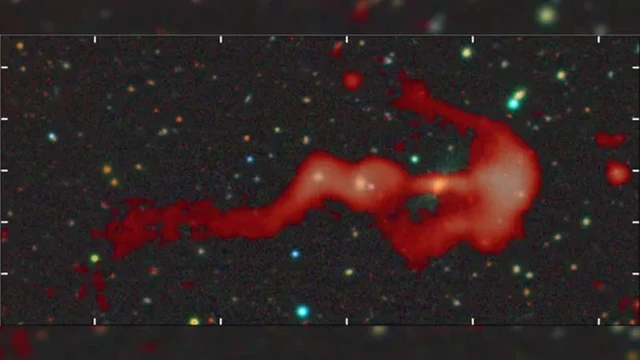
Deep within the cosmic void, approximately 2 billion light-years from Earth, an object has been detected that challenges our conventional understanding of symmetry in radio galaxies. Designated as RAD J104501.6+352852 (or RAD-BAARG for short), the entity was discovered through a potent synergy of professional instrumentation and citizen science. An analysis of data from the LOFAR Two-metre Sky Survey, conducted by a participant in the RAD@home project, revealed a structure that astronomers have aptly dubbed the "bow and arrow."
The scale of this formation is staggering: the arc of the "bow" spans 1.8 million light-years. To put this into perspective, it is 18 times the diameter of our own Milky Way. Such dimensions point to the immense energy being unleashed at the system's core, where an Active Galactic Nucleus (AGN), powered by a supermassive black hole, generates colossal streams of plasma.
The defining characteristic of RAD-BAARG is its striking asymmetry in radio emission. In classic radio galaxies, jets—highly collimated streams of matter ejected by a black hole in opposite directions—typically form relatively symmetrical structures. In this instance, however, we observe a complex, sinuous S-shaped geometry. To capture this phenomenon, researchers utilized the LOFAR antenna array at a frequency of 144 MHz. This low-frequency range was critical, as it allowed scientists to "see" an aging population of relativistic electrons and the faint synchrotron radiation that remains virtually invisible at higher frequencies.
Synchrotron radiation occurs when electrons, traveling at speeds approaching that of light, spiral through magnetic fields. In the case of RAD-BAARG, this process served as a mechanism for visualizing the invisible.
Data analysis suggests that the RAD-BAARG galaxy plowed into the dense, high-temperature medium of a galaxy cluster at supersonic velocities. This rapid intrusion triggered the formation of a shock front—a region of abrupt gas compression and heating. As the black hole's jets traversed this turbulent environment, they functioned effectively as a cosmic searchlight, illuminating the boundaries of invisible gas flows and shock waves.
This discovery holds profound implications for astrophysics. If the hypothesis regarding the "illumination" of the shock front is confirmed, RAD-BAARG will become an archetypal case of how the activity of supermassive black holes can be leveraged to map the large-scale structures of the universe. In this light, galactic jets are transformed into diagnostic tools, enabling the study of the dynamics of evolving galaxy clusters and the behavior of the intergalactic medium—elements that would otherwise remain entirely undetectable to modern telescopes.
 Drones for Cloud Cover Management Over Solar Power Plants