Tactile perception remains one of the most formidable challenges in modern robotics, highlighting a profound disparity between biological precision and mechanical execution. Conventional approaches to simulating touch typically fall into two traps: they either demand prohibitive computational overhead or suffer from inadequate resolution. Researchers at Queen Mary University of London have devised an elegant solution by bridging the gap between optics and materials science. This innovation allows robots to literally "see" touch, translating physical pressure into a dynamic color map. Such an approach paves the way for the development of robotic manipulators with a level of sensitivity that rivals the human touch.
The biological sophistication of the human hand is staggering: over ten thousand mechanoreceptors allow us to instantaneously discern the texture of a fabric, the density of an object, or the slightest slip of an item between our fingers. For robotics, achieving such sensor density has long been an elusive ideal. Previous attempts to replicate this mechanism typically hit a hardware wall: systems either lacked the physical sensors required for granular perception, or the processing of the resulting data deluge demanded computational power far beyond what could be integrated into a compact manipulator.
A solution proposed by British researchers shifts the challenge from the realm of electronics to optics. Rather than attempting to densify a grid of electrical sensors, the team developed a soft tactile sensor that translates mechanical deformation into a visual signal. At the core of the device is an elastic Bragg reflector sandwiched between two layers of soft silicone.
The device operates on the principle of structural color. Unlike conventional dyes, a Bragg reflector changes hue based on the distance between the layers of its structure. When the robot makes contact with an object, the silicone deforms, altering the reflector's geometry. This creates a specific color pattern at the point of contact, which directly correlates to the applied pressure and the surface topography.
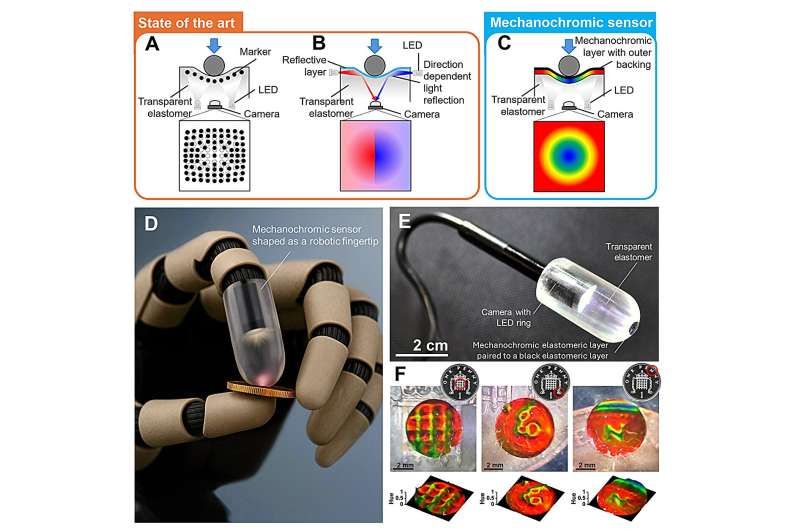
This approach enables the use of a standard USB camera as the primary reading device. The camera captures a "load color map," which the system then interprets. This removes the need for complex signal analysis algorithms typically required for thousands of individual electrodes, as the contact data is already presented as a clear, intuitive image.
From a technical standpoint, this method resolves the fundamental conflict between resolution and response latency. Traditional tactile systems—whether capacitive, resistive, or piezoelectric—are limited by the physical size of their cells and the complexities of contact routing, which rarely allow for a resolution finer than 1 mm. Conversely, while machine-vision systems can detect minute details, they often overwhelm the processor. The London-based development allows for the differentiation of surface elements with a pitch of approximately 100 $\mu$m in real-time, all while placing minimal strain on the computational core.
The practical potential of this "smart skin" is immense. In the industrial sector, it could lead to the creation of grippers for microelectronics assembly, where precise pressure control is critical to avoid damaging fragile components. In medicine, the technology could be transformative: surgical robots could gain the ability to distinguish between healthy and pathological tissues by touch, significantly increasing operative precision. Finally, in the field of prosthetics, such a system would provide users with rich tactile feedback, bringing the functionality of artificial limbs closer to their biological counterparts.
 Next-Generation Ultra-Lightweight Lens Technology