The deployment of heavy-lift satellites to geostationary and interplanetary orbits has long been contingent upon the efficiency of upper-stage propulsion systems. China has now achieved a significant technological breakthrough with the unveiling of a liquid-propellant engine boasting unprecedented operational longevity. This innovation does more than merely accelerate the deployment of satellite constellations; it fundamentally redefines the parameters for transporting ultra-heavy payloads. We are witnessing a new benchmark in endurance—one that challenges the long-standing dominance of Western technology in the apogee kick motor segment.
In modern spaceflight, the transition from a transfer orbit to the target orbit represents a critical mission phase. This is where apogee kick motors (AKMs) come into play—propulsion systems engineered to operate under extreme temperature fluctuations and aggressive chemical environments. Recent tests conducted by the Chinese Academy of Aerospace Propulsion Technology in Xi'an have revealed the emergence of a potential game-changer in this segment.
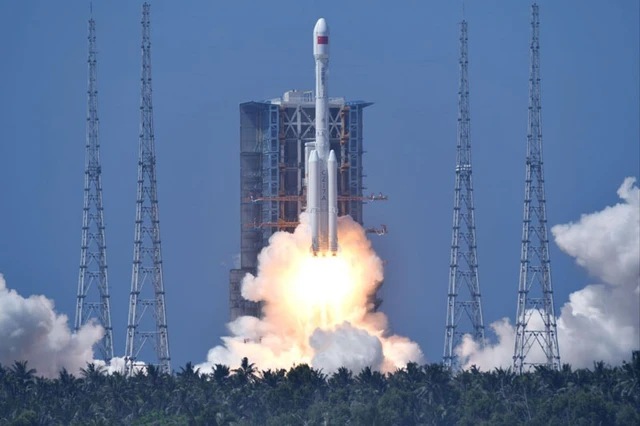
A new propulsion system delivering 750 N of thrust has undergone successful validation in the actual environment of space. The engine was integrated into the 26A communications satellite, which was launched into orbit on June 23, 2026, via a Long March 7A rocket from the Wenchang Spacecraft Launch Site. After reaching its transfer trajectory, the unit executed a series of precise maneuvers, successfully hoisting the spacecraft into a geostationary orbit (GEO) at an altitude of 35,800 km.
The engineers' primary breakthrough lies in the radical extension of the engine's operational lifespan. During the mission, the unit completed five ignition cycles, with a total burn time of 11,617 seconds (approximately 3.2 hours). However, the technology's true potential was unveiled during ground testing, where the engine withstood over 14 hours of continuous operation, significantly exceeding its 10-hour design specification. For chemical engines of this class, this is an outstanding result, as repeated ignition cycles impose colossal thermal and oxidative stresses on the combustion chamber and nozzle.
The secret to this durability is rooted in advanced materials science. The developers implemented an innovative protective coating that effectively resists high-temperature corrosion and oxidation. This allows the engine to maintain nominal performance characteristics even during prolonged operation, effectively doubling the total endurance seen in many Western counterparts.
When evaluating efficiency through the lens of specific impulse ($I_{sp}$)—the gold standard for rocket fuel economy—the Chinese unit demonstrates a result of approximately 320 seconds. This places it on par with the industry's established leaders. For comparison, the European LEROS-1B offers 635 N of thrust with a minimum impulse of 317 s, while the American R-42DM from Aerojet Rocketdyne delivers 890 N with an impulse of 327 s. While the power output is comparable, the operational lifespan becomes the decisive competitive advantage.
The practical implications of this breakthrough extend far beyond raw data. The combination of high thrust and increased durability allows for a reduction in the orbit-raising time for heavy payloads by approximately 30% compared to the previous generation of Chinese engines (400 N). This not only accelerates the deployment of satellites into service but also yields significant fuel savings. This preserved propellant can then be utilized for subsequent orbital corrections, directly extending the operational lifespan of expensive space assets.
Looking ahead, this technology paves the way for the development of heavy interplanetary transport systems. Chinese engineers have already outlined the next step: the development of ultra-high-power engines with thrust up to 5,000 N. Such units will serve as the heart of massive space tugs capable of moving heavy cargo between orbits, effectively transforming near-Earth space into a fully realized logistics network.
 Next-Generation Ultra-Lightweight Lens Technology