Black holes persist as some of the most enigmatic entities in the cosmos, fundamentally challenging our understanding of the laws of physics. The theoretical framework of Hawking radiation posits that these gravitational behemoths can slowly evaporate over time; however, detecting this phenomenon in the depths of space remains an almost insurmountable task, obscured by overwhelming electromagnetic noise. To test this hypothesis, researchers are engineering terrestrial analogues of these extreme environments, leveraging cutting-edge techniques in quantum optics. Their latest experiment has gone beyond merely simulating an event horizon, enabling a granular analysis of the system's energy dissipation dynamics.
The quest to replicate black hole physics in a laboratory setting has undergone a significant evolution. In the early stages, researchers relied on rudimentary models—even simple vortices in a sink—to visually demonstrate the principle of matter accretion. These were eventually superseded by more sophisticated systems utilizing supercooled fluids, where quantum effects allowed for the observation of phenomena vaguely resembling Hawking radiation. However, the fundamental challenge remained the study of the energy transfer mechanism itself: the precise process by which a black hole "surrenders" its mass to radiation.
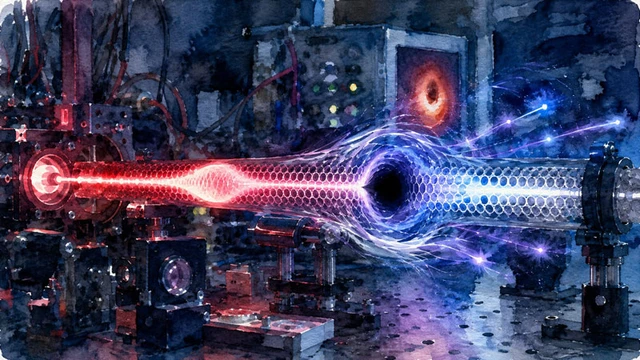
To address this, a team from the University of Paderborn adopted a fundamentally different approach, engineering an optical system based on a nonlinear crystal acting as a waveguide. In this setup, physicists simulated the behavior of light in the immediate vicinity of an event horizon. On an astrophysical scale, the event horizon is a mathematical boundary beyond which the escape velocity must exceed the speed of light, rendering exit impossible. In this laboratory model, a powerful, short laser pulse traveling through an optical fiber served as the functional analog to this boundary.
The mechanics of the process rely on the modification of the medium's physical properties. As the intense laser pulse traverses the crystal, it temporarily alters the material's refractive index, which directly impacts the speed of light propagation. For a second, weaker probe pulse, this region becomes a kind of "moving wall" or barrier that cannot be crossed under normal conditions. This dynamic boundary functioned as the laboratory equivalent of the event horizon.
When the weak pulse interacted with this region, a radiative transformation occurred: a portion of the light shifted its frequency, generating pairs of signals. The characteristics of these pairs are identical to those predicted to be generated by Hawking radiation in actual black holes.
However, the most significant breakthrough was the observation of the "back-reaction"—the inverse effect of this process on the system itself. The researchers recorded a simulation of a black hole's energy loss. In the experimental context, this manifested as an energy redistribution within the primary laser pulse: a fraction of its power was consumed to create new light components with different frequencies. This process mirrors the theoretical mechanism by which a real black hole gradually loses mass and energy, eventually leading to its complete evaporation.
Capturing such faint signals required surgical precision. The scientists performed a detailed comparative analysis of the light spectra before and after the interaction, filtering out spurious optical effects and recording radiation in the ultraviolet range. An analysis of the signal's dependence on the probe pulse's power revealed that one part of the effect grows linearly while the other grows quadratically, aligning perfectly with theoretical calculations.
While the authors cautiously note that it is impossible to entirely rule out all secondary nonlinear processes in such a complex system, the experiment provides a critical trajectory for future research. While not a direct proof of the evaporation of actual astrophysical objects, it vividly demonstrates the energy transfer mechanisms at the wave level. The study's primary conclusion challenges previously accepted theories: it appears that the cascading mechanism by which a black hole's energy transitions into Hawking radiation is far simpler and more linear than previously assumed.
 Next-Generation Ultra-Lightweight Lens Technology