The advancement of quantum computing and secure communication networks hinges on the ability to engineer stable, controllable sources of single photons. For years, the primary means of tuning these emitters relied on adjusting chemical compositions or applying external fields—approaches that severely constrained system flexibility. Researchers at the University of Technology Sydney have introduced a radically different paradigm, leveraging the mechanical alteration of material geometry. By manipulating the relative alignment of atomic layers, the team has succeeded in creating what is essentially a programmable source of quantum light.
At the heart of modern quantum technologies lies the quest for the ideal emitter—a system capable of generating photons with strictly defined characteristics. Traditionally, this has relied on solid-state platforms, such as silicon carbide or diamonds featuring nitrogen-vacancy (NV) centers. However, these materials possess a rigid three-dimensional structure, rendering their properties virtually immutable once synthesized. Any attempt to "tune" the emission wavelength in such crystals requires either intricate chemical doping or the application of powerful external fields, both of which significantly complicate the architecture of the final device.
Two-dimensional materials have emerged as a compelling alternative, with hexagonal boron nitride (hBN) standing out as one of the most promising candidates. Its structure resembles a stack of atomically thin sheets, each consisting of a stable hexagonal lattice. The defining characteristic of hBN is the presence of point defects within its crystalline structure. These defects function as quantum emitters: they trap electrons and emit light, with the resulting parameters dictated by the local atomic environment.
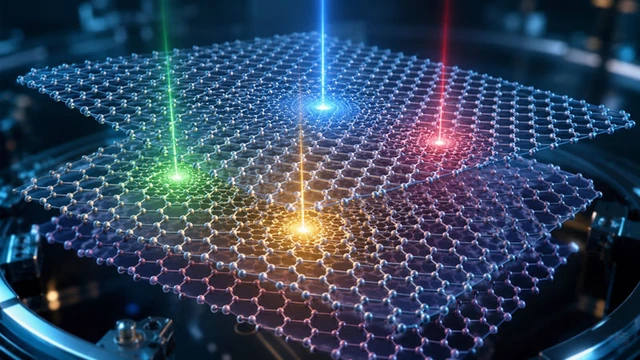
Unlike bulk 3D crystals, hBN layers possess unique mechanical flexibility. They can be isolated, repositioned, and, most crucially, rotated relative to one another. This specific property has allowed researchers to apply the principles of "twistronics"—a nascent field of physics that explores how the properties of materials change when their layers are mutually rotated.
The conceptual precursor to this method was the discovery of the "magic angle" in graphene. In that instance, rotating two layers of graphene led to a radical shift in electrical conductivity, transforming the material from a standard semiconductor into a superconductor. In their work with boron nitride, researchers discovered a similar phenomenon, though manifested in the optical spectrum.
Through iterative experimentation, multilayer hBN structures were disassembled and reassembled with varying twist angles. It became evident that this angle serves as a kind of "mechanical tuning knob": by altering the mutual alignment of the lattices, scientists could control the color and wavelength of the emission from the quantum defects. The resulting spectral shift proved to be significantly more pronounced than anything achievable through traditional defect management in diamonds.
From a physical standpoint, this process is driven by changes in the local electronic environment and interlayer interaction. The rotation of the layers modifies the energy landscape surrounding the defect, which directly influences the energy of the optical transition and, consequently, the wavelength of the emitted photon.
This breakthrough elevates layered materials from the role of passive substrates to that of active control instruments. The ability to literally "dial in" a light source to a specific mode paves the way for the creation of compact, scalable, and high-precision devices for quantum cryptography and ultra-sensitive sensors, where the precise tuning of emission frequency is a critical factor for success.
 Semiconductors for 600°C Operation