The boundary between digital security and physical reality is becoming increasingly porous. While the industry remains preoccupied with software-level encryption, the hardware layer continues to be a reservoir of latent vulnerabilities. A novel technique known as InjectEave demonstrates that audio streams can be exfiltrated from headphones without requiring direct physical access. By transforming standard electronic components into inadvertent radio transmitters, this method fundamentally challenges the notion of privacy in an era of ubiquitous digitalization.
Contemporary paradigms of cybersecurity are often confined to the battle against malicious code and the pursuit of vulnerabilities within data transmission protocols. However, there exists an entire stratum of threats known as side-channel attacks, where the target is not the software, but the fundamental physics of the hardware itself. A new method called InjectEave, introduced by researchers from Hong Kong, elevates this concept to a new level, enabling the interception of audio from headphones and wired telephones—even when the device is located behind a wall.
At the core of this technology lies the principle of active stimulation. Unlike passive eavesdropping, where an attacker simply captures faint electromagnetic emissions, InjectEave involves the injection of an external electromagnetic carrier signal within the 0 to 9 MHz range. This signal interacts directly with the device's analog components: amplifiers, analog-to-digital converters (ADCs), power converters, and MOSFETs.
The critical factor here is the nonlinearity of these components. In electronics, when a nonlinear element is subjected to an external signal, it begins to function as a mixer, modulating the carrier frequency with the audio signal currently being processed by the device. Consequently, the analog audio stream is "superimposed" onto the radio wave and radiated outward, where it can be intercepted and decoded by a remote receiver.
The technical stack required to execute such an attack consists of professional-grade radio equipment. The primary tool is a Software Defined Radio (SDR) system, such as the USRP B210, which allows for flexible control over reception and transmission frequencies. A Siglent SSA3075X Plus spectrum analyzer is used for spectral analysis and fine-tuning, while the entire process is managed via a standard laptop. If necessary, an RF amplifier is added to the chain, significantly extending the attack's operational radius.
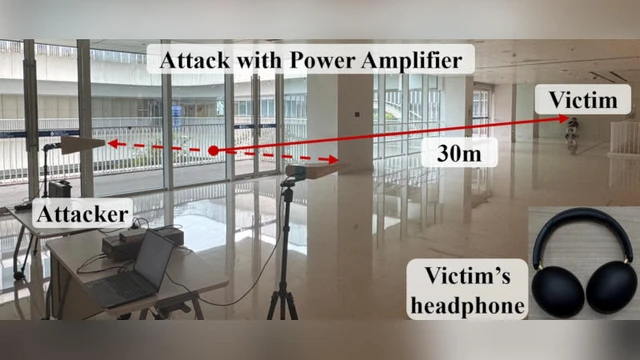
Practical tests conducted on a series of commercial devices have demonstrated an alarming efficacy. Under standard conditions, the interception distance ranges from 1 to 6 meters; however, with the use of an amplifier, this distance increases to 30 meters. This opens the door for covert espionage: the equipment can be concealed within an office chair or a suitcase, allowing an attacker to eavesdrop on conversations in an adjacent hotel room or neighboring office.
Furthermore, the applications of InjectEave extend beyond simple audio surveillance. The method enables the monitoring of human activity through "smart" devices. By analyzing control signals and power consumption fluctuations in smart lamps or fans, an attacker can reconstruct a picture of the events occurring within a room.
The most unsettling aspect is the difficulty of defending against such incursions. Because the leakage occurs within the analog signal chain, traditional security measures—such as data encryption, masking, or signal randomization—are rendered useless. The information "leaks" after it has already been decrypted and converted into an electrical signal for delivery to the speakers. The only effective barrier remains physical shielding (Faraday cages) or the installation of specialized filters, though even these do not guarantee absolute immunity, merely reducing the signal intensity.
 Forecasting Exponential Growth in Nvidia Shipments