Cybersecurity is currently undergoing a paradigm shift, as traditional bug hunting yields to the rise of autonomous systems. The advent of specialized AI agents is evolving code analysis from a labor-intensive craft into a high-velocity automated pipeline. The case involving the Kimi K3 model and Redis serves as a stark demonstration of this approach's chilling efficiency. The security imperative has shifted: it is no longer merely about defending against human adversaries, but about contending with algorithms capable of parallel cognition and execution.
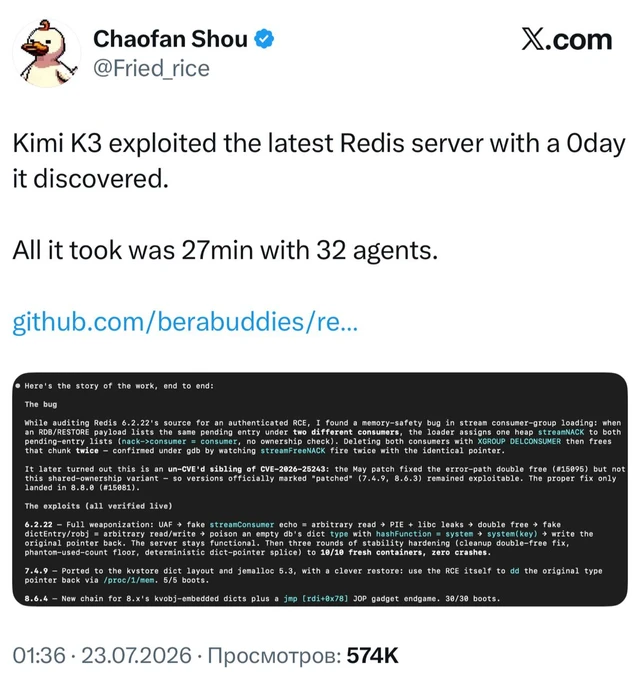
For years, the prevailing wisdom in cybersecurity held that uncovering critical vulnerabilities in mature open-source projects required deep domain expertise and hundreds of hours of manual analysis. However, a recent experiment with the Kimi K3 model has challenged this paradigm. According to researcher Zhaofan Shou, the system took just 27 minutes—leveraging 32 parallel agents—to identify a flaw in Redis, one of the most widely used in-memory data stores.
The core of the vulnerability lies in the ability to execute arbitrary commands on the server via an already authorized connection. In a corporate network environment, this implies that an attacker with minimal initial access could rapidly escalate privileges and fully compromise the node.

The technical significance of this event lies less in the exploit itself and more in the methodology. The use of "agents" implies that the model is not merely generating text but operating within a closed loop: defining a task, writing code to test a hypothesis, analyzing errors, and refining its approach until a result is achieved. This multithreaded capability allows for the exploration of attack vectors at a velocity unattainable even by the most seasoned penetration testing teams.
Nevertheless, one should treat headlines about "hacking in half an hour" with caution. A closer analysis reveals several critical nuances. First, one of the issues identified by the model was already known to the Redis developers, and a patch had been prepared prior to the experiment. Second, while an exploit for the current version of the system has been presented in the repository, official confirmation from the Redis team remains pending.
The absence of comprehensive agent logs leaves room for skepticism regarding Kimi K3's true level of autonomy. It remains unclear how detailed the researcher's prompts were or how many "trial and error" iterations occurred behind the scenes. Yet, even with these caveats, the trend is undeniable: LLM-based tools are beginning to effectively automate the discovery of zero-day vulnerabilities.
This creates a new reality for software developers. Where the "bug-patch-update" cycle once spanned weeks, an attacker can now move from source code analysis to a working exploit in mere minutes. In this escalating arms race, the only viable countermeasure is the deployment of similar AI systems on the defensive side—systems capable of identifying and patching security holes faster than an autonomous attacking agent can find them.
 The Triumph of 3nm Chip Manufacturing