The global semiconductor industry is undergoing an unprecedented financial surge, redefining traditional understandings of market cycles. The primary catalyst has been the meteoric rise of generative AI, which has triggered an immense demand for specialized compute capacity. Latest data from research firm Omdia confirms that the sector has entered a trajectory of hypergrowth, shattering historical records. This trend signals a fundamental shift in the economics of digital hardware.
The second quarter of this year marked a watershed moment for the semiconductor sector: industry revenue surged by 31.4%, hitting a record high of $425 billion. This trajectory does more than just validate market viability; it serves as empirical evidence that the AI boom has evolved from a theoretical trend into a powerhouse financial engine. In aggregate, market participants accumulated $752 billion in the first half of the year, signaling a steady acceleration in growth compared to the first quarter, where the increase stood at 29.2%.
To grasp the scale of this shift, one must look at the historical data. Since 2002, sequential revenue growth exceeding 10% has occurred in only ten out of ninety-seven quarterly reports. However, starting in the third quarter of last year, the industry entered a phase of sustained double-digit growth—a trend that Omdia forecasts will persist into the near future.
The primary catalyst for this rally has been the memory segment. A sharp spike in component pricing has propelled memory revenue to a dominant share of total earnings, accounting for 54% in Q2. For context, this figure stood at 45% in Q1 and rarely climbed above 30% prior to last autumn.
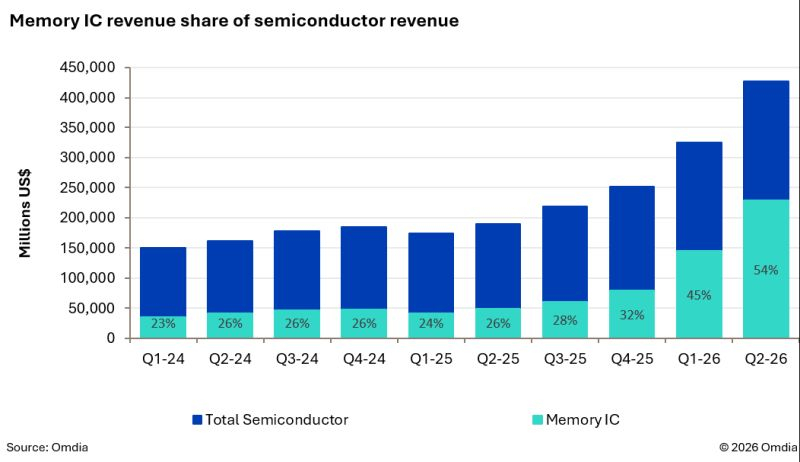
This growth is systemic, spanning all critical product categories: DRAM, NAND, and NOR. Each of these categories has recorded absolute revenue peaks. Crucially, even when stripping away the influence of the memory segment, the broader semiconductor sector grew by over 10%—far outpacing the 23-year historical average of approximately 3% for the same period.
Simultaneously, the microprocessor segment is delivering impressive results. Revenue here climbed by 16%, dwarfing the typical seasonal increase of 1%. This synergy between memory capacity and compute cores is driven by the demands of modern Large Language Models (LLMs), which necessitate massive bandwidth and high data density.
The outlook for the coming months is even more ambitious. Q3 revenue is expected to breach the psychological threshold of $500 billion. Consequently, cumulative year-to-date revenue for semiconductor suppliers will surpass $1.25 trillion. The current pace is so aggressive that the results of the first three quarters alone will exceed the previous peak year by 50%, cementing semiconductors as the primary strategic resource of the modern digital economy.
 The Commercial Debut of the Googlebook Ecosystem