The pursuit of reusability in modern aerospace is no longer the sole domain of a single private entity; it has evolved into a high-stakes global technological rivalry. China has made a decisive leap forward, successfully demonstrating the recovery of a launch vehicle's first stage onto a maritime platform. This milestone marks a pivotal shift from theoretical exploration to the operational deployment of sophisticated dynamic capture systems. Beijing now possesses the tangible technological foundation required to drastically slash the cost of delivering payloads into orbit.
Recent developments in the South China Sea mark a pivotal inflection point in the evolution of the East's aerospace program. The flight of the CZ-10B (Long March 10B) was far more than a routine mission to deliver cargo into low Earth orbit; it served as a comprehensive demonstration of engineering mastery in the realm of recoverable systems.
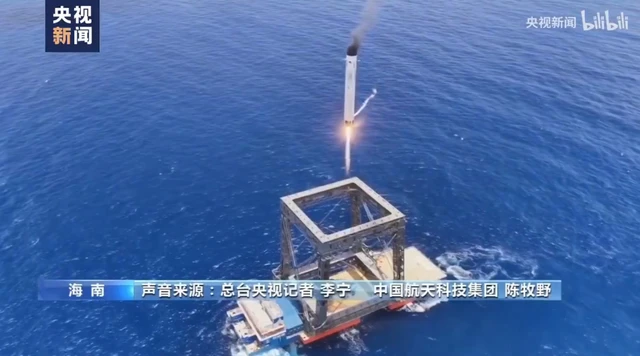
The launch took place from a facility on Hainan Island. Six minutes after ignition, the vehicle executed a nominal stage separation, after which the first stage began an intricate recovery maneuver. Diverging from the conventional approach of utilizing landing legs, Chinese engineers employed an experimental "net-capture" method. Maintaining a vertical orientation, the booster performed a controlled descent onto the Linghangzhe, a specialized maritime platform positioned 430 kilometers from the launch site.

The implementation of a net-capture system is an audacious engineering gambit that distinguishes China's approach from its Western counterparts. By shifting the complexity from the vehicle to the ground-based—or in this instance, maritime—infrastructure, this system optimizes the rocket's mass efficiency by eliminating the need for heavy landing gear. Meanwhile, the second stage operated nominally, ensuring the precise insertion of the payload into its designated orbital slot.
The technical specifications of the CZ-10B underscore China's ambition to develop versatile and high-efficiency systems. The vehicle is a two-stage liquid-propellant system featuring a hybrid fuel cycle. The first stage utilizes a proven liquid oxygen (LOX) and kerosene combination, providing the massive thrust required to penetrate the dense layers of the atmosphere. The second stage, however, employs a more advanced and promising propellant pairing: liquid oxygen and methane. Methalox engines are widely regarded as the industry gold standard for future reusable systems due to their higher efficiency and reduced carbon buildup (coking), both of which are critical for long-term operational sustainability.
The vehicle's scale is formidable: with a length of 63 meters and a diameter of 5 meters, its liftoff mass reaches 760 tons. This places the CZ-10B firmly in the category of heavy-lift launch vehicles capable of executing large-scale strategic state objectives.
This launch effectively validates China's capability to execute the controlled return of a first stage. It is not merely a technical success, but a strategic leap that lays the groundwork for accelerated deep-space exploration. The transition to reusable technology allows for a manifold increase in launch frequency and a significant optimization of space program budgets, transforming space from a domain of exceptional, singular achievements into a sphere of routine and scalable logistics.
 Space Debris Poses a Growing Threat to Low Earth Orbit Constellations