The global AI surge is fundamentally restructuring the hierarchy of tech titans, elevating highly specialized components to the status of the modern era's most critical assets. At the heart of this tectonic shift lies the high-performance memory sector, where the long-standing hegemony of diversified conglomerates is being eclipsed by a new era of strategic specialization. The meteoric rise of SK hynix, which recently surpassed Samsung Electronics in market capitalization, serves as a definitive signal that the technological cycle has shifted. Market valuation is no longer a reflection of imperial scale, but rather a measure of a company's capacity to fuel the next generation of neural networks.
The contemporary semiconductor landscape is undergoing a period of unprecedented upheaval. Companies capable of satiating the voracious demands of AI infrastructure are rapidly closing in on the $1 trillion market capitalization milestone. In this climate, Samsung Electronics' long-standing hegemony in South Korea has come under threat: SK hynix has not only closed the gap but has surged to the top of the country's public company rankings, reaching a valuation of $1.35 trillion.
SK hynix's growth trajectory has been nothing short of phenomenal, with its share price skyrocketing by 340% since the beginning of the year. This rally has allowed the company to outpace not only its perennial rival in Seoul but also the American giant Micron Technology. Notably, SK hynix's success is rooted in a fundamentally different business model. While Samsung operates as a massive conglomerate with a diversified portfolio—spanning everything from consumer electronics to proprietary microprocessors—SK hynix has bet its future on hyper-specialization in memory production.
The ascent to the top of the market was far from linear. The history of SK hynix reads like a corporate thriller: in 2002, the company narrowly avoided a takeover by Micron, and by 2003, it was grappling with a collapse in share prices to all-time lows. However, its current 13th-place ranking among the world's most valuable companies serves as a testament to the efficacy of its strategic pivot.
The primary engine of this surge has been High Bandwidth Memory (HBM). In the era of Large Language Models (LLMs) and generative AI, standard memory has become a "bottleneck," throttling the performance of Graphics Processing Units (GPUs). HBM solves this crisis by providing colossal data transfer speeds. SK hynix has managed to secure a commanding lead in this segment, controlling 61% of global shipments. For comparison, Micron holds 21%, while Samsung trails with just 17%.
SK hynix's strategic advantage lies not only in volume but in the creation of so-called "vendor lock-in." As noted by Chey Tae-won, Chairman of SK Group, the nature of HBM is such that products from different manufacturers are virtually non-interchangeable. This binds clients to a specific supplier at the system-design level, creating a formidable barrier to entry for competitors.
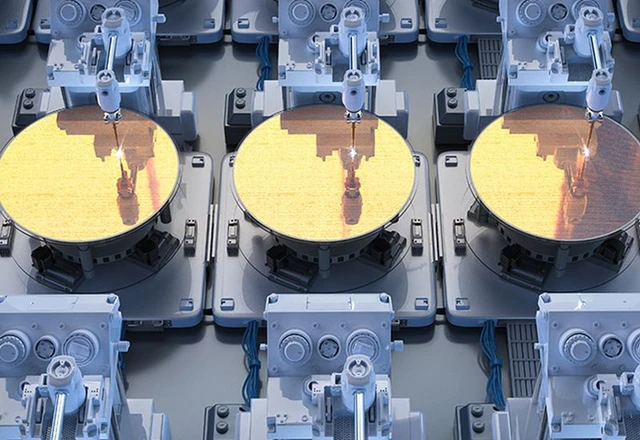
Despite its dominance in the HBM segment, Samsung Electronics still maintains the lead in aggregate DRAM production volumes. However, this gap is narrowing rapidly. According to Bank of America analysts, SK hynix's current wafer throughput (589,000 per month) is now closely approaching Samsung's figures (691,000).
The outlook for the coming years is even more aggressive: by 2028, SK hynix plans to expand its production capacity by 38%, while Samsung's growth rate is expected to be less than half of that. While the DRAM volume gap stood at 23% last year, it could shrink to 10% by 2028. Such expansion will inevitably lead to a convergence of profit margins between the two giants.
To further solidify its position and tap into new capital streams, SK hynix is considering a U.S. IPO via the Nasdaq. Such a move could definitively cement the company's status as a global technological leader, capable of dictating the terms of the AI-dominated era.
 The Economic Paradox of the GeForce RTX 5090