Europe is once again asserting its ambitions for strategic space sovereignty. The launch of the Ariane 6 in its most powerful configuration was more than a mere commercial success; it served as a critical validation of the region's technological prowess. The successful deployment of the massive Amazon Leo satellite constellation underscores the European aerospace industry's capacity to ensure reliable, frequent orbital access for heavy-lift payloads. By bridging a perilous gap in launch capabilities, this mission restores the EU's standing as a primary contender in the global launch services market.
The Kourou Spaceport in French Guiana recently marked a pivotal moment in contemporary European astronautics. Following a brief technical hiatus caused by a launch delay, the Ariane 6 heavy-lift vehicle ascended, carrying 36 Amazon Leo satellites. This mission transcends the mere fulfillment of a commercial contract; it serves as the definitive litmus test for a system designed to restore Europe's strategic autonomy in delivering heavy payloads to both deep space and low Earth orbit (LEO).
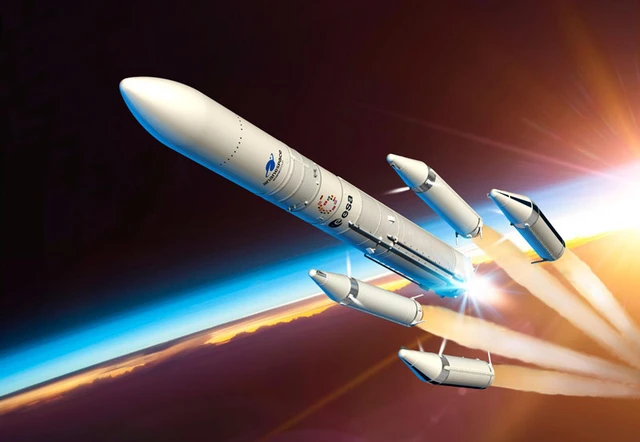
The mission's primary technological breakthrough was the deployment of modified P160C solid rocket boosters. Unlike their P120C predecessors, these upgraded boosters feature expanded propellant chambers, adding 14 tons of additional fuel to each unit. This surge in energy potential allowed the Ariane 6 to reach its maximum design payload capacity for the first time, cementing the rocket's status as a true heavyweight in the modern orbital fleet.
The partnership with Amazon has evolved into a strategic alliance: under a comprehensive agreement, Arianespace is slated to execute a series of 18 launches. The current mission represents a critical milestone, bringing the total number of Amazon Leo satellites deployed by the Ariane 6 to approximately 100 over the last five months. Against a backdrop of failures and setbacks from other providers, the European launcher has effectively emerged as the sole dependable vehicle for deploying this constellation, significantly bolstering Europe's prestige among the world's leading tech giants.
The deployment process was executed with surgical precision. Following liftoff, ground control confirmed the nominal operation of all systems—from booster separation and fairing jettison to the activation of the core stage. The final phase of the mission fell to the upper stage, powered by the high-efficiency Vinci liquid oxygen/liquid hydrogen engine. According to the flight profile, the satellite release sequence began ninety minutes after launch, with the full deployment of all 36 spacecraft spanning nearly two hours—a feat requiring exceptional stability from the guidance, navigation, and control (GNC) systems.
Behind this technological triumph lies a massive industrial consortium. The creation of the Ariane 6 is the result of a synergistic effort involving enterprises from more than ten countries. German production facilities in Bremen, Augsburg, Ottobrunn, and Lampoldshausen played a decisive role in developing the rocket's critical components. Consequently, this successful flight is not only an engineering victory but a triumph of pan-European industrial cooperation, proving its viability in an era of fierce competition with private aerospace firms.
 SpaceX’s Hundred-Billion Dollar Leap into Louisiana