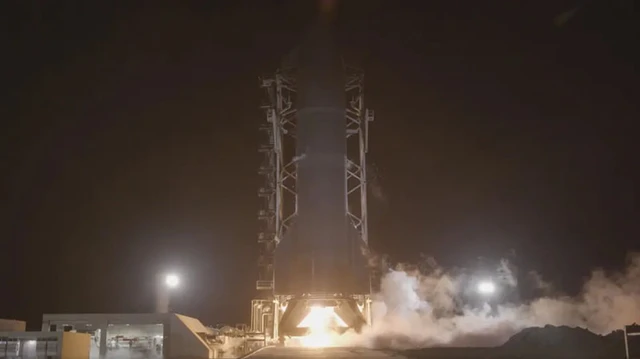
Outer space is steadily evolving into an orbital junkyard of spent rocket stages and satellite fragments, introducing precarious new risks for interplanetary missions. The recent collision between a Falcon 9 upper stage and the Moon serves as a stark illustration of this systemic issue. While direct visual confirmation of the impact remains elusive, spectral analysis has allowed scientists to meticulously reconstruct the event. This incident provides a unique window into the dynamics of high-velocity collisions within low-gravity environments.
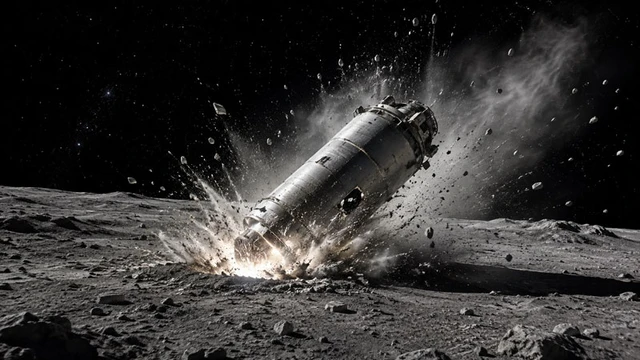
The morning of August 5 witnessed an event that provided definitive confirmation of a long-standing theory: the inevitability of space debris colliding with natural satellites. Object 2025-010D—a spent Falcon 9 upper stage weighing approximately four tons—slammed into the lunar surface at a velocity of roughly 2.4 km/s. The impact occurred in a region challenging for Earth-based observers, situated between the Einstein and Bell craters on the western limb of the Moon's visible disk.
In the absence of real-time visual confirmation from telescopes or current imagery of the fresh crater, the primary evidence rests on spectroscopic data. The European Southern Observatory's Very Large Telescope (VLT) in Chile detected an extensive plume of ejecta rising tens of kilometers above the surface immediately following the calculated time of impact.
Of particular interest to scientists is the chemical composition of this cloud, which revealed traces of sodium and lithium. While sodium is a typical component of vaporized lunar regolith, the presence of lithium points unequivocally to an anthropogenic origin. As a constituent of the rocket stage's materials, lithium served as a "chemical fingerprint," virtually eliminating any doubt regarding the reality of the collision.
The trajectory of this object began on January 15, 2025, when a Falcon 9 launched the Blue Ghost and Resilience spacecraft toward the Moon. Following payload separation, the upper stage remained in space with no means of controlled deorbit. Over the ensuing months, it was subject to complex gravitational interactions between the Earth, Moon, and Sun, which, coupled with solar activity, gradually altered its course. Ultimately, this path led to an inevitable conclusion—a scenario that experts at NASA's Center for Near-Earth Object Studies had predicted with absolute certainty.
The primary objective now is to quantify the impact's aftermath. According to preliminary models, the collision may have left a crater between 18 and 40 meters in diameter and approximately three and a half meters deep. To verify these findings, researchers plan to leverage orbital assets: NASA's Lunar Reconnaissance Orbiter (LRO) and South Korea's Danuri station, utilizing its ShadowCam instrument.
Comparing "before" and "after" imagery will not only refine the dimensions of the resulting crater but also provide critical data on ejecta distribution during high-velocity impacts. In a broader context, this incident underscores the urgent need to enhance monitoring methods for cislunar space, which is becoming increasingly congested due to the proliferation of man-made objects.
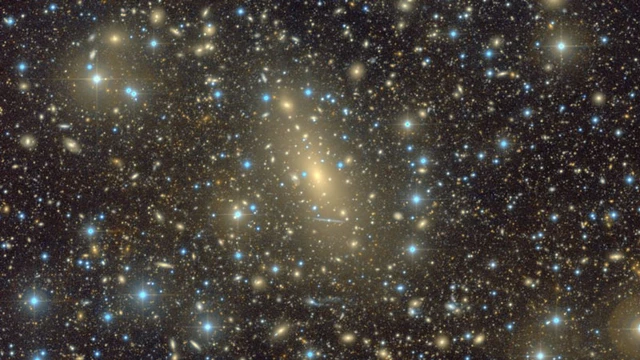 The Phenomenon of the Supermassive Galaxy IC 1101