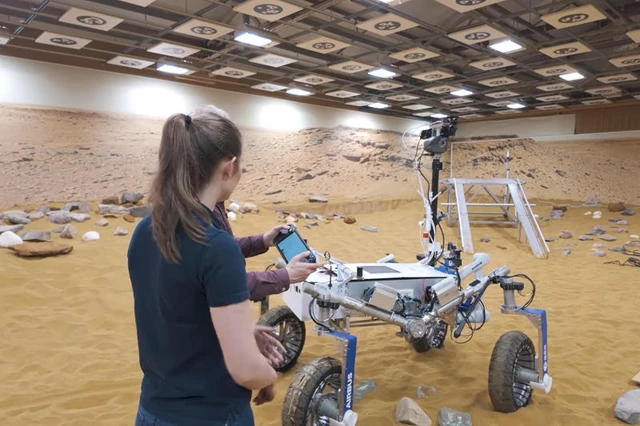
Deep space exploration demands a delicate equilibrium between total system autonomy and the precision of human oversight. While operational Mars rovers must operate autonomously due to staggering signal latency, ground-based testing necessitates an interface that is as intuitive as possible. Airbus engineers have found an unexpected solution within the realm of consumer electronics: the deployment of a Steam Deck to control the ExoMars prototype underscores the rapid convergence of gaming hardware and professional-grade robotics.
Designing exploration vehicles for the Red Planet is fraught with a fundamental challenge—the physical limitation of the speed of light. The vast distances render real-time control impossible; signal latency is simply too high. Consequently, the ExoMars rover must possess a high degree of autonomy, processing data from 3D cameras and making navigational decisions independently to avoid becoming bogged down in sands or colliding with rock formations.
During ground testing, however, the requirements shift. Engineers need a tool for direct, agile control of the prototype to calibrate algorithms and validate the machine's responses. The traditional setup of a laptop paired with an external controller often proves cumbersome and inefficient. As an alternative, Airbus specialists opted for the Steam Deck.
The decision to use Valve's handheld console is driven less by its "gaming" nature and more by its technical architecture. The Steam Deck is essentially a fully-fledged, compact x86-based computer running Linux. The integration of a built-in display with physical sticks, triggers, and buttons creates an ergonomic interface, granting operators a level of comfort and precision unattainable with standard peripherals.
This use case underscores a significant trend in the modern industry: the line between specialized equipment and high-performance consumer gadgets is blurring. Valve's philosophy of maximum system openness allows for the installation of any third-party software or even alternative operating systems.
Ultimately, the requirements for a high-quality gaming device—computational power, OS stability, and an intuitive interaction interface—are virtually identical to those required for an effective robotics control tool. The deployment of the Steam Deck in Airbus laboratories demonstrates that high-quality hardware remains high-quality, regardless of whether it is intended for virtual battles or the real-world conquest of Mars.
 Qualcomm’s New Standard for Mobile Performance