Modern power grids are hitting a ceiling in terms of precision with conventional monitoring techniques, while simultaneously facing an escalating barrage of cybersecurity threats. The shift toward quantum technologies promises a fundamental leap in the resilience of critical infrastructure, leveraging entirely new paradigms for measurement and data security. In China, an ambitious pilot project has been launched to develop a "quantum substation"—an integrated ecosystem that fuses quantum sensing, communications, and computing into a unified operational loop. This initiative serves as a critical proving ground for tools poised to redefine the operational paradigm of global electrical grids.
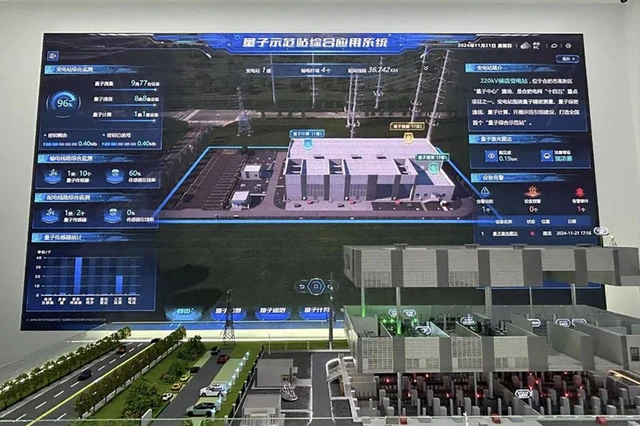
The city of Hefei, Anhui Province, has seen the commissioning of the Houdian Quantum Application experimental 220 kV substation. More than just a power node, this facility serves as a comprehensive technological laboratory where 85 sets of diverse equipment are being operationalized in real-world conditions. The integration of quantum solutions spans three fundamental pillars: precision measurement, secure communications, and high-performance computing.
The centerpiece of the system is an innovative quantum current transformer. Unlike traditional electromagnetic devices, which are susceptible to magnetic saturation and thermal fluctuations, this system utilizes nitrogen-vacancy (NV) centers in synthetic diamonds. This technology enables the registration of magnetic fields with unprecedented accuracy—particularly when measuring low currents—which is critical for the early detection of grid anomalies.
Beyond transformers, the infrastructure is augmented by a comprehensive stack of quantum sensors. The deployment includes tower position monitors and discharge detectors within distribution cabinets, as well as specialized instruments for monitoring cable overheating. Of particular note is the quantum lidar, capable of analyzing atmospheric conditions and cloud cover within a 15-kilometer radius, allowing operators to forecast external environmental impacts on power lines.
Data security is addressed through the implementation of fiber-optic Quantum Key Distribution (QKD) systems. Combined with "5G plus quantum encryption" communication protocols, this creates a virtually impenetrable channel for operational data, shielded from interception even by the theoretical capabilities of future quantum computers.
The project's computational power is focused on optimizing energy flow distribution. To calculate voltages and capacities across all network nodes, an experimental algorithm was deployed and tested on the Origin Wukong superconducting quantum computer. While the project remains in the demonstration phase and has yet to prove absolute superiority over classical control systems, the successful application of a quantum processor for grid analysis paves the way for next-generation "smart grids."
Practical results already confirm the economic viability of this approach. According to the network operator, the use of quantum instrumentation has reduced electricity metering errors by more than 500 MWh annually. The precision of certain sensors has increased by two orders of magnitude—improving from one-thousandth to one-hundred-thousandth of the measured value. The success of the Hefei experiment has already triggered the scaling of this technology across other sites in Anhui Province, with long-term prospects for national integration and expansion into higher voltage classes.
 The Orbital Leap of the Starship System