The global energy transition demands a new class of materials—those capable of transcending the physical and economic constraints inherent to traditional silicon. For decades, the industry has been tethered to rigid panels whose manufacturing is notoriously energy-intensive. Now, however, perovskites—organic-inorganic halides boasting exceptional optical properties—have emerged as a disruptive alternative. Recent large-scale trials in China have confirmed that these materials are finally ready to migrate from the laboratory to commercial application. These results signal the dawn of a new era in solar power generation, where peak efficiency is paired with a radical reduction in production costs.
For too long, modern photovoltaics have been held captive by silicon. While reliable, silicon panels demand complex, high-temperature purification and crystal growth processes, resulting in modules that are heavy, rigid, and costly to produce. Perovskites have emerged as the viable alternative—materials with a crystalline structure that enables far more efficient light absorption within significantly thinner layers. The pivotal technological breakthrough has been the shift toward thin-film inkjet printing, transforming the fabrication of solar cells from a heavy industrial process into a form of high-tech printing.
However, the path to commercialization for perovskites was blocked by a critical vulnerability: extreme instability when exposed to ambient humidity. The material would literally degrade under environmental stress, neutralizing any gains in efficiency. Overcoming this required a fundamental redesign of the protective layers' chemical composition. Researchers from Nanjing University, in collaboration with engineers from Renshine Solar, developed a dual-component surface passivation system. First, iodide salts are applied to the cells to create ultra-strong interfacial adhesion, followed by the application of lead compounds. This method establishes a hermetic, chemically stable barrier that shields the active layer from degradation.
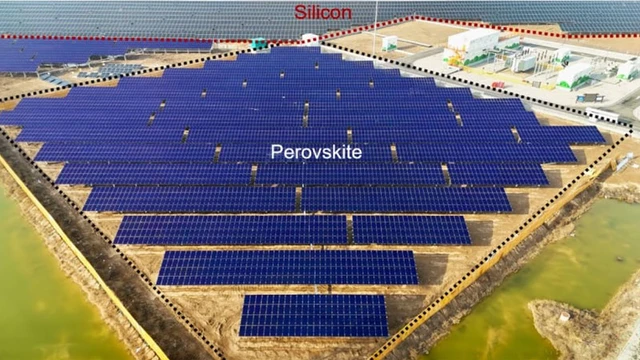
The practical validation of this technology was conducted on an unprecedented scale: a 1 MW solar plant was deployed and benchmarked against a traditional 3.5 MW silicon installation. The results of a three-month monitoring period were striking. When normalized by installed capacity, the perovskite system consistently outperformed its silicon counterpart: the yield increase was 3.42% in March, 3.79% in April, and widened to 5.81% by May. Notably, the advantage of perovskites grew in proportion to rising ambient temperatures and solar intensity, making them ideal for hot climates.
Technical benchmarks for individual modules confirm high scalability potential. A test sample with an area of 810 cm² achieved a certified efficiency of 24.0%. During this, the open-circuit voltage reached 53.46 V, while the short-circuit current was 0.436 A, with a fill factor of 83.4%. Scaling up to industrial formats—modules with an area of 0.72 m²—the average power output was 144 W. The top performer among 150 manufactured samples demonstrated an efficiency of 22.0% and a power output of 158.4 W. Furthermore, under Maximum Power Point Tracking (MPPT), the system stably maintained outputs above 158 W for several hours—a record for modules of this size.
The crowning achievement was the confirmation of long-term durability. During a 1,300-hour stress test at 85% temperature and humidity, modules featuring the new coating lost only 2% of their initial efficiency. In contrast, standard samples lost nearly 40% under the same conditions. Successfully passing the comprehensive IEC 61215 standard tests effectively resolves the final concerns regarding the industrial viability of perovskites. In the global race for green energy supremacy, China and Japan are currently the most aggressive contenders, and these breakthroughs by Chinese researchers may define the landscape of global energy for decades to come.
 Next-Generation Ultra-Lightweight Lens Technology