The modern AI tech stack is typically synonymous with high-performance GPUs and cloud computing, yet the industry's true dependencies run far deeper, anchoring themselves in the realm of fundamental materials science. While market attention remains captivated by the titans of Silicon Valley, the genuine beneficiaries of the neural network era are found within the most unexpected sectors of Japanese industry. These are companies whose traditional portfolios may seem worlds apart from the digital sphere, yet whose specialized breakthroughs have become mission-critical for semiconductor fabrication. This paradox illustrates how niche chemistry and ceramics are, in reality, dictating the velocity of global digital progress.
When we discuss AI supply chains, the conversation typically gravitates toward ASML’s lithography machines or TSMC’s fabrication plants. Yet, beneath this visible surface lies a layer of "invisible" suppliers whose products provide the physical foundation upon which modern chips are built. Japanese firms such as Toto, Nittobo, and Ajinomoto have become striking examples of how ancillary technical expertise can evolve into a primary driver of capitalization when the market faces an unprecedented surge in demand for computing power.
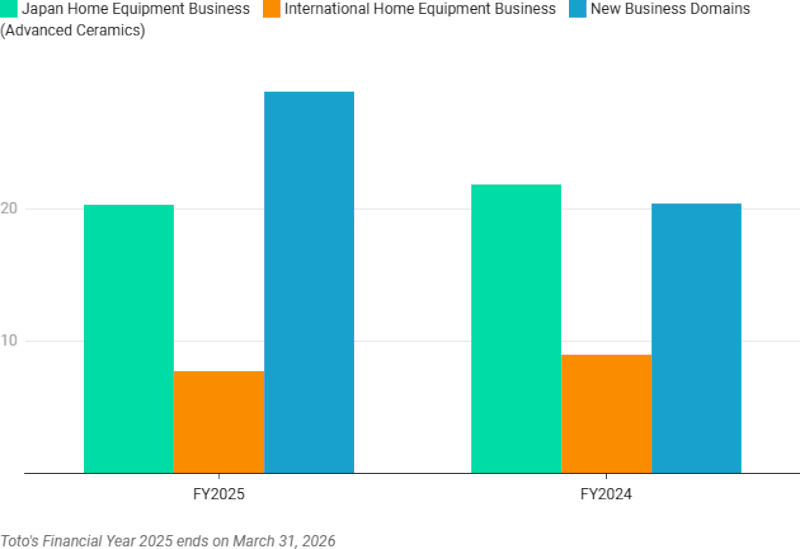
The trajectory of Toto is a classic study in successful diversification. Globally renowned for its high-end sanitary ware, the company spent decades refining its expertise in advanced ceramics. In 1988, this knowledge crystallized into the development of ceramic electrostatic chucks. These devices play a critical role in the silicon wafer etching process: they secure wafers with extreme precision, directly impacting production yields and overall semiconductor manufacturing efficiency. Today, the advanced ceramics segment has effectively become Toto's growth engine, delivering rapid increases in revenue and operating profit while its traditional home equipment business remains stagnant.
Nittobo followed a similar path. Originally specializing in textiles and fiberglass, the company integrated its developments into the electronics industry as early as the mid-80s. Its T-glass product became an indispensable component for printed circuit boards (PCBs) and electronic modules. With the boom in AI servers, demand for high-quality fiberglass used in semiconductor substrates has multiplied. For Nittobo, electronic materials are no longer merely a supplementary line—they have become the core of the business, accounting for the vast majority of the company's total revenue growth over the last fiscal year.
Perhaps the most surprising case is Ajinomoto. A company synonymous with monosodium glutamate and food additives has unexpectedly emerged as an indispensable player in high-performance computing. While working with by-products of food component production, the company developed a unique insulating material known as ABF (Ajinomoto Build-up Film). This polymer is used in semiconductor packaging, enabling the creation of the complex multi-layer structures essential for modern CPUs and GPUs.
As chip architectures grow more complex and requirements for interconnect density increase, the significance of ABF only intensifies. The impact of this material on Ajinomoto's financial performance has become so profound that the "Healthcare and Others" segment—which encompasses film production—has surpassed even the company's core frozen food business in terms of profitability.
Ultimately, the success of the modern AI industry rests upon a deep foundation of materials science built over decades. The ability of these Japanese companies to pivot their expertise in ceramics, glass, and food chemistry into high-tech semiconductor solutions underscores a vital thesis: the digital revolution always has a physical manifestation, and controlling that manifestation becomes the ultimate strategic advantage.
 Anthropic’s Record-Breaking Public Market Debut