The global energy sector is in pursuit of a sustainable alternative to lithium-ion technologies, which are increasingly constrained by resource scarcity and mounting environmental risks. Contemporary energy storage systems are frequently hampered by premature electrode degradation and inefficient charge recovery rates. A breakthrough by Australian researchers proposes a transition toward aqueous chemistry—a paradigm that marries inherent safety with exceptional durability. This innovation has the potential to fundamentally redefine the stabilization of renewable energy grids on a global scale.
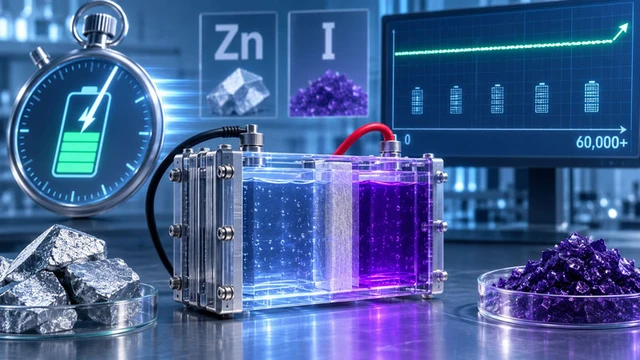
In the contemporary energy storage landscape, striking the ideal balance between charging velocity and cycle life remains the preeminent engineering challenge. Researchers from Flinders University in Adelaide have unveiled a solution that effectively redefines the capabilities of aqueous electrolytes. Their newly developed zinc-iodine battery demonstrates performance metrics previously considered unattainable for such systems: a lifespan exceeding 60,000 charge-discharge cycles and a full energy recovery time of just three minutes.
This technological leap was made possible through a profound molecular-level modification of the electrolyte chemistry. The system utilizes an aqueous solution based on potassium iodide, augmented with zinc chloride and ethylene glycol. This specific combination effectively resolves two fundamental flaws inherent in aqueous batteries: the unbridled growth of zinc dendrites and the migration of polyiodides between electrodes.
Within this architecture, ethylene glycol serves as a stabilizer, forming a solvation shell around the iodine ions. This significantly reduces their mobility and inhibits their migration across the separator membrane. Simultaneously, chloride ions are adsorbed onto the zinc anode, guiding the metal deposition along a safe crystallographic plane. Consequently, the formation of acicular structures (dendrites)—which in traditional systems inevitably lead to internal short circuits and cell failure—is eliminated.
The device's operational metrics are compelling: at a current density of 20 mA/cm² and a voltage of up to 1.3 V, the battery achieves a full charge within minutes. Even after 60,000 cycles at 100% depth of discharge (DoD), the battery retains nearly 84% of its original capacity. Furthermore, the device exhibits high Coulombic efficiency (99.7%), a figure validated through testing of pouch cells with a capacity of 2.1 Ah.
The architectural simplicity of the solution is particularly noteworthy. Unlike complex redox flow batteries, this system requires no pumps, external reservoirs, or electrolyte circulation systems. This significantly streamlines scalability and reduces the capital expenditure (CAPEX) required for implementation. Additionally, ethylene glycol acts as an effective antifreeze, extending the operational temperature range from −20 °C to +60 °C. Even under extreme cold, the system retains 78% of its capacity, making it viable for deployment across diverse climatic zones.
From a strategic standpoint, the transition to zinc-iodine systems is critical. Australia holds the world's largest zinc reserves (approximately 28% of global resources), enabling a complete decoupling from lithium imports and costly components sourced from China.
While the energy density of this development is lower than that of cutting-edge lithium-ion batteries, this deficit is mitigated in the stationary storage segment. For grids with a high penetration of solar and wind generation—where long-duration energy storage (LDES) of four to eight hours is required—the determining factors are the cost per cycle and the system's response time. In this context, the new technology emerges as a formidable competitor not only to lithium but also to expensive vanadium systems, offering the industrial sector a reliable and accessible tool for energy management.
 Next-Generation Ultra-Lightweight Lens Technology