The pursuit of reusability has emerged as the defining paradigm of modern astronautics, drastically slashing the cost of delivering payloads into orbit. China is aggressively aligning itself with this global trajectory, developing proprietary systems for the vertical recovery of rocket stages. The most recent flight of the Zhuque-3 demonstrated the technical maturity of its landing mechanisms, notwithstanding a dramatic conclusion. This incident underscores the critical complexities inherent in managing residual propellant during the mission's terminal phase.
August 19 marked a pivotal milestone for China's private aerospace sector. LandSpace successfully launched the Zhuque-3 carrier rocket, a mission designed not only to deploy a satellite into orbit but to validate the concept of first-stage recoverability. The technical execution was flawless: following separation, the second stage successfully delivered the payload into space, while the first stage initiated a controlled descent.
Shortly after liftoff, the reusable stage achieved a soft landing on a designated pad located 390 kilometers from the launch site. This maneuver represents the most critical phase of the mission, demanding exacting precision from navigation algorithms and braking systems. The fact that the vehicle stabilized on its landing gear in a vertical position confirms the success of LandSpace's engineering solutions regarding dynamic descent control.
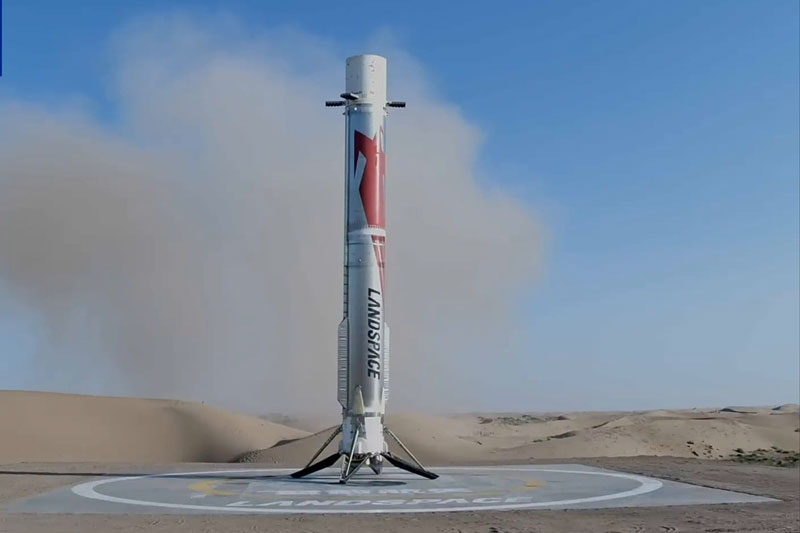
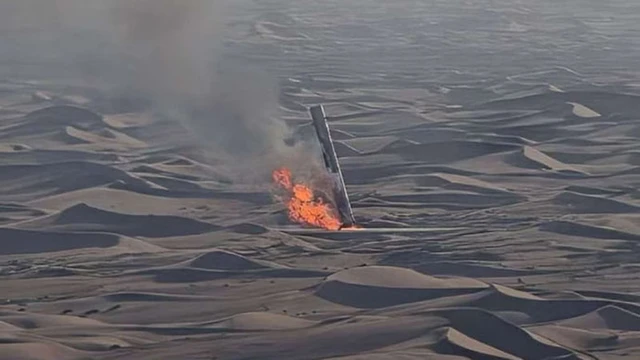
The victory, however, proved fleeting. Just two minutes after touchdown, the stage was engulfed in flames. Preliminary analysis indicates that the fire originated in the lower section of the structure. The likely cause was the ignition of residual liquid methane and liquid oxygen—the propellant pair utilized by the Zhuque-3. While methane has become the modern industry standard for reusable systems due to its lower tendency to cause engine coking, it demands extreme caution during the drainage of residual fuel post-landing.
The thermal impact proved fatal for several structural elements. Although the landing legs themselves were constructed from heat-resistant stainless steel, the carbon-composite components providing their structural integrity could not withstand the intensity of the fire. Consequently, one of the supports failed, causing the 66-meter structure to lose equilibrium and tip over.
Despite the physical loss of the vehicle, the mission is regarded as a success from an engineering perspective. The primary objective—demonstrating the capability for a safe soft landing and the stabilization of a multi-ton structure on the ground—was achieved. The subsequent fire is classified as an operational incident, which will be addressed by optimizing fuel line purging systems.
LandSpace's achievement fits into the broader trajectory of China's space ambitions. Earlier this year, the state-owned CALT corporation demonstrated a similar result. Consequently, China has effectively established two independent technological stacks for the development of partially reusable rockets. This fosters internal competition and accelerates the transition toward a model of high-frequency, low-cost launches—a critical requirement for the deployment of large-scale satellite constellations.
The next launch attempt for the Zhuque-3 is scheduled before the end of the year. The updated version of the system is expected to feature reinforced landing gear and a revised protocol for handling fuel residues, effectively resolving the post-landing safety concerns.
 Next-Generation Ultra-Lightweight Lens Technology